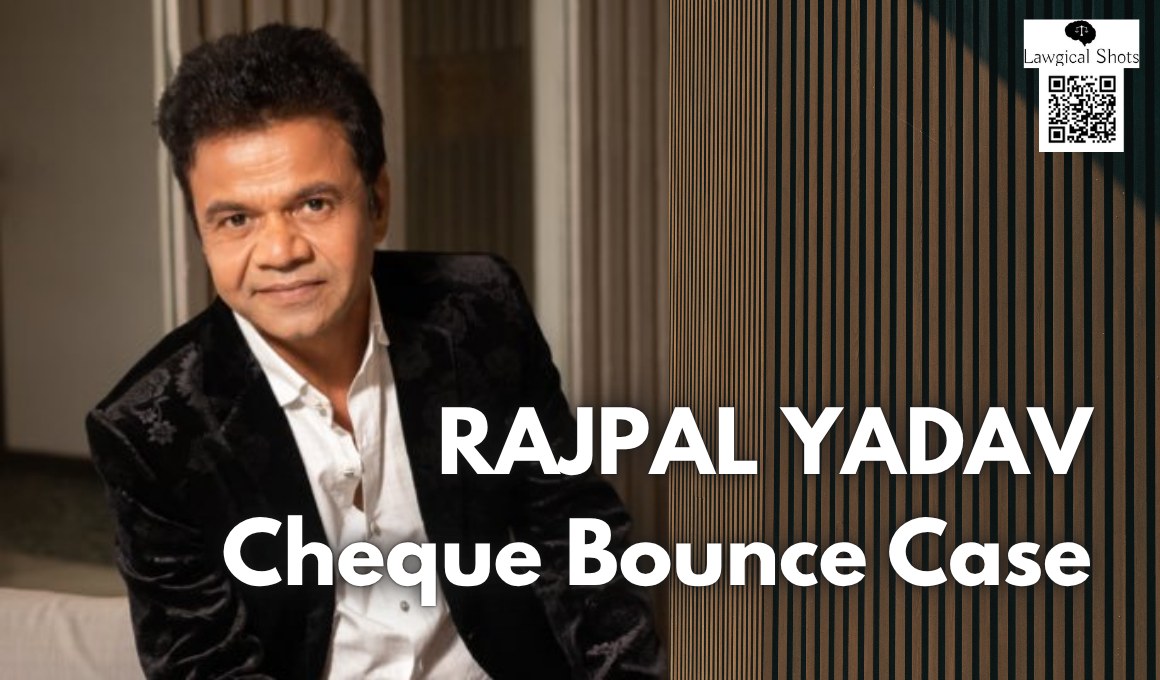

The Rajpal yadav Cheque Bounce case has drawn renewed attention after the Delhi High Court upheld the actor’s conviction. Rajpal Yadav has been sentenced to jail in a batch of seven connected matters. This article lays out the background of the dispute, the trial court proceedings, the interim relief granted to the actor earlier this year, and the final order sentencing Rajpal Yadav to three months’ imprisonment.
Background: How the Rajpal Yadav Cheque Case Began
The dispute traces back to 2010, when Rajpal Yadav reportedly took a loan of Rs 5 crore from M/s Murli Projects Private Limited to finance Ata Pata Laapata, his directorial debut. The film released in 2012 but did not perform well commercially, and the actor allegedly failed to repay the loan as agreed. That’s how
As repayment did not materialise, several cheques issued by Rajpal Yadav and his wife, Radha Rajpal Yadav, towards clearing the dues were dishonoured on presentation. This led the complainant company to initiate proceedings under Section 138 of the Negotiable Instruments Act, 1881 (the provision that criminalises the dishonour of a cheque issued for the discharge of a debt or liability). Seven separate complaints were filed in connection with the dishonoured cheques, giving rise to what is now widely referred to as the rajpal yadav cheque bounce case. That’s how Rajpal Yadav cheque amount of Rs 5 crores segregated in multiple cases summed up the criminal proceedings against him.
Trial Court and Sessions Court Proceedings
In 2018, a Magistrate’s court convicted Rajpal Yadav and his wife in the cheque bounce case and sentenced them to six months of simple imprisonment. The Rajpal Yadav cheque amount in dispute, along with accumulated interest and penalties over the years, was reported to have risen to nearly Rs 9 crore by 2024.
Rajpal Yadav challenged the conviction before higher forums. In May 2024, a Sessions Court examined the appeal, upheld the conviction, and again sentenced him to six months’ imprisonment in the cheque dishonour case. The actor then moved the Delhi High Court against this order, keeping the Rajpal Yadav cheque case pending before the High Court for an extended period, marked by adjournments and repeated attempts at an out-of-court settlement, including a reference to the Delhi High Court Mediation Centre that did not result in a resolution.
Interim Relief Granted Earlier This Year
Over the course of the High Court proceedings, Rajpal Yadav was granted certain interim reliefs conditional on partial payment to the complainant.
- In February 2026, the Delhi High Court, finding that Yadav had not complied with its earlier directions, ordered him to surrender before jail authorities. His request for additional time to surrender was rejected.
- Yadav surrendered on 5 February 2026 and was taken into judicial custody.
- He subsequently secured an interim suspension of his sentence after depositing Rs 1.5 crore with the complainant.
- The interim relief was extended on more than one occasion during further hearings, including an extension till 1 April 2026, with the Court making clear that no further adjournment would be granted beyond that date.
- During these hearings, Yadav sought additional time, at one stage requesting 30 days to arrange Rs 6 crore towards a one-time settlement, but the Court declined to grant further extensions, observing that repeated assurances had not been honoured with actual payment.
Despite the interim suspension and the opportunities extended to him, the outstanding amount was not cleared in full, which set the stage for the High Court’s final order.
What the Delhi High Court Decided
On the final hearing, Justice Swarana Kanta Sharma of the Delhi High Court pronounced judgment in the batch of seven cases filed by M/s Murli Projects Private Limited. The Court’s key findings and directions were as follows:
- The conviction of Rajpal Yadav under Section 138 of the Negotiable Instruments Act was upheld in all seven cases.
- The sentence was modified from the six months awarded by the sessions court to three months of simple imprisonment in each case, with the rajpal yadav imprisonment terms directed to run concurrently rather than consecutively.
- Yadav was directed to pay Rs 1.05 crore to the complainant in each of the seven cases, along with smaller additional amounts, reported as Rs 1.04 lakh and Rs 75,000, to the complainant, and Rs 25,000 to the State.
- His wife, Radha Rajpal Yadav, was directed to pay a fine of over Rs 5 lakh (reported as Rs 5,51,380) in each case.
- The Court clarified that the Rs 2.25 crore already deposited by Yadav during the proceedings would be adjusted against the total amount payable.
- The Court granted Yadav a period of two months to challenge the judgment before a higher forum.
In its reasoning, the Court noted that Rajpal Yadav in this cheque bounce case had been given multiple opportunities to honour the settlement he had repeatedly assured the Court he would fulfil, but had failed to do so despite these opportunities. This finding of repeated non-compliance formed the basis for the Court declining to extend further relief and for it confirming that Rajpal Yadav is sentenced to jail in each of the seven cases.
Current Status of Rajpal Yadav Case
With this order, the Delhi High Court has brought the appellate stage of the Rajpal Yadav cheque bounce case to a close, while leaving open the possibility of a further challenge within the two-month window granted by the Court. The matter also continues to carry civil liability implications, since the payment directions run independently of the custodial sentence.