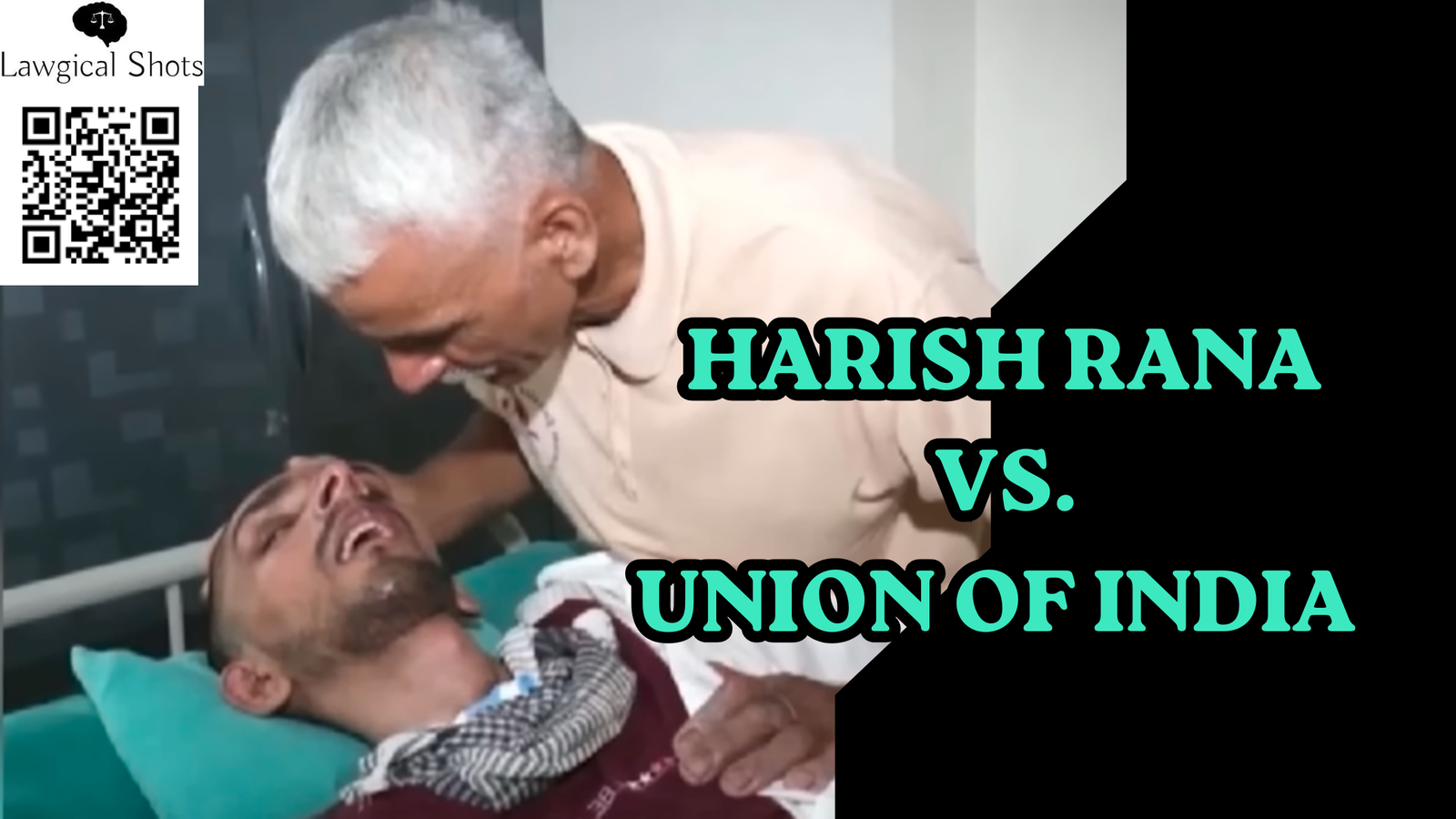

At the intersection of law, justice, and human life, we have the right to die with dignity. The depths of right to die with dignity have been discussed in the recent judgment of Harish Rana vs. Union of India, decided on March 11, 2026 by the Supreme Court of India.
Justice J.B. Pardiwala started with a quote of Henry Ward Beecher, “God asks no man whether he will accept life. That is not the choice. You must take it. The only choice is how.” They said these words carry a huge weight in deciding, “whether an individual can choose to accept life by preferring to die.” Later, Shakespearean dilemma of “to be or not to be” also emphasized for deciding whether right to life includes right to die as well? Here, we will look at what prompted the Apex Court to allow its first case of passive euthanasia and in what circumstances it may be allowed in future as well.
Factual Matrix in Harish Rana Case
The applicant, Harish Rana was a 32 year old man on the day of decision. However, the plight concerns an almost 20 boy whose life changed with a tragic fall. On the evening of August 20, 2013 around 6:00 PM, he fell from the fourth floor of his paying guest accommodation. As a consequence he suffered “diffuse axonal injury”, which means his brain was injured because of tearing or stretching of nerve fibers (axon). This damage is diffused i.e., spread across various areas/spots of the brain. It was not one spot injury. Axons carry signals in the brain, which got disrupted, thereby affecting communication in the brain. He was kept in PGI, Chandigarh where he was administered treatment in the form of conservative management, which means without surgery, wait, and support approach. It included AED (Automated External Defibrillator) to save from cardiac arrest, analgesics, ventilator, antibiotics, tracheostomy, and feeding through a Ryle’s tube (nasogastric tube).
Even after his discharge at the time, frequent hospitalization had always been a necessity. He had a history of seizures in 2014. From 2016 he was put on anti-seizure medications. He could not interact with others because of his medical condition. There were no facial gestures when he was hungry or soiled himself. He was bed-ridden and not responsive to any auditory, verbal, tactile (touch), or painful stimulus. He was in a “Persistent Vegetative State”. His parents were taking care of him along with the help of his siblings from the past 13 years. Now the parents were worried that if any of them die, then who will look after him? Every Medical board set up according to the “Common cause guidelines”, said that Harish Rana was incurable owing to his brain injury. So the family moved to the Supreme Court to take necessary steps so that he does not suffer this way. The family believed that Harish was suffering immensely, so his pain should come to an end. Both the team of doctors, i.e. doctors from both primary and secondary medical boards, also believed that Harish Rana would never be able to get back to normal life as PEG tubes were inserted all over his body.
When Passive Euthanasia Allowed in India?
After perusal of all the facts and listening to the arguments of both the petitioner and the Union of India, Apex Court framed an issue:
Whether, when and on what legal basis can medical treatment be withdrawn or withheld?
Other Key issues
- Whether CANH (Clinically Assisted Nutrition and Hydration) is “medical treatment”?
- What is the meaning, scope, and contour of “best interest” of the patient?
- Whether continuation of life-sustaining treatment is justified as the best interest of the patient?
- What procedure is required to be followed for the withdrawal of life support?
- Whether existing guidelines on passive euthanasia need to be modified?
Common Cause vs. Union of India (2018)
Hon’ble Court discussed the principle laid down in Common Cause vs. Union of India (2018) and line of reasoning adopted in that judgment. The majority opinion was:
- “Right to die with dignity” is inherent under “right to live with dignity” in Article 21 of the Constitution of India;
- Both Passive Euthanasia” and AMD, Advanced Medical Directive, where a person can state in advance what kind of treatment they want or they do not want, are legal and permissible within article 21;
(I) Active Euthanasia vs. Passive Euthanasia
In deciding the distinction between “active” and “passive” euthanasia, the Apex Court perused the relevant portion of the Common Cause judgment of 2018. The Court found that the distinction does not lie in “act” or “omission” of it. The true distinction lies in the “source of the harm that leads to death”.
In active euthanasia, there is an external source like a lethal injection or a drug that speeds up the death, while in passive euthanasia the physician only allow the underlying illness or fatal condition to take its natural course by removing the interventions (any action or support taken by a doctor to treat a medical condition) that were only artificially prolonging life and not providing any therapeutic effect.
But passive euthanasia must not be the omission of duty to take care by a medical professional which she or he owes to their patient. In a nutshell, active euthanasia is causing death while passive euthanasia is letting die or allowing death to occur.
(II) Passive Euthanasia in interface with Article 21
Article 21 of the Constitution of India makes it compulsory to not deprive any person from his life and personal liberty. Their life and personal liberty can only be taken away by the established procedure by law. The hon’ble Court highlighted the judgment of Common Cause (2018), and discussed the non-negotiable aspect of life, “dignity”. Dignity is the unification of all the fundamental rights. Part III of the Constitution of India provides basic rights to every person so that they can live their life with dignity. Dignity is the normative basis, which means foundation or why behind the right to life and other fundamental rights. Dignity is essential for determining the true scope and reach of these articles.
The Court further went on with the “sanctity of life” principle which says that dignity is inherent in every human, so ending life purposefully is against the dignity of the concerned person. This “sanctity of life” principle forms the very basis of Article 21.
In Parmanand Katara v. Union of India, reported in (1989) it was held by the Supreme Court held that there is no provision in any Indian law that prevents any doctor from providing immediate medical attendance to any patient. If anyone is a victim of an accident then all doctors including private and government hospitals have to provide medical attention immediately. Preservation of life is paramount and is a legal obligation under Article 21 of the Constitution. Right to life and personal liberty includes the right to health and prompt medical attention. Medical treatment must be prioritized over procedural formalities like police reports or medico-legal cases(MLC). Regardless of a patient being an offender or innocent/victim no police action or state action can prevent a doctor in fulfilling their duty to save life.
Then a conflicting view of the “Quality of life” proposition was discussed, which says leaving the world in a peaceful and dignified manner is also within the constitutional guarantee of dignified life. That decision was a jurisprudential analysis of the right to die with dignity in view and the meeting of dignity, privacy, autonomy, and liberty. Dignity must be infused at every stage of human existence from the first breath to the last. The decisions regarding death are private and intimate. A patient has an unconditional right to refuse the treatment. No justification lies to a State or any third entity behind the refusal. But sometimes a patient is not in a fit condition to make a decision regarding his treatment, then in such eventuality some other can make a decision which is called relational autonomy. In relational autonomy focus shifts from individualistic choice to environment and relationships. Therefore, family members or the next of kin or next friend can step into the shoe of the concerned patient when traditional understanding of autonomy, i.e, self-government become challenged on account of the unconscious state of the patient. In simple terms, everyone is socially embedded. No one is an island who can survive alone. Identity of an individual is shaped by the convergence or meeting of family, ethnicity, gender, education. If anyone who cannot take care of himself left abandoned or uncared will perish. So, his next of friends, kith or kin need to come forward to save him by taking the decision regarding his life and dignity.
Issues Raised in Harish Rana vs Union of India Judgment
First issue: CANH (Clinically Assisted Nutrition and Hydration) as “Medical Treatment”
CANH (Clinically Assisted Nutrition and Hydration) means feeding by tube or through veins. It does not cover oral feeding by cup, spoon, bottle etc.
It is of two types:
- Enteral nutrition which means providing nutrition by PEG tubes.
- Parenteral nutrition which is giving nutrition through gastrointestinal (GI) tract.
The hon’ble Supreme Court held that CANH is a medical treatment. The court reasoned that CANH is not a common knowledge. Administration of CANH depends upon medical skills, protocol, and expertise. Removing it from the “medical treatment” will deprive primary care physicians from responsibly assessing the therapeutic value of this medical facility in the discharge of their duty of care. Even if the CANH is administered by a lay person at home still it is under medical supervision. It can be awarded a non-medical status. It requires close consideration of the dosage and its frequency, regular cleaning of PEG tubes to prevent clogging. Most importantly, “Artificial nutrition and hydration, draws upon and depends upon medical knowledge.” A patient should not be made a passive subject of medical technology without allowing the doctors to make clinical decisions regarding this intervention. CANH requires emergency management in case the PEG tube gets infected or dislodged from the administered site.
Second issue: “Best Interest of the Patient” in determining whether medical treatment should be withdrawn or withheld
There are two types of patients with regard to the “best interest of the patient” principle. One is “Competent” patients, and the other is “incompetent” patients. “Competent “ patients are those who can give their informed consent regarding the treatment; whereas “incompetent” patients are those who are not in a fit condition to give informed consent regarding their choice of medical treatment. So, which medical treatment is suitable for such patients rests with the competent medical experts.
Understanding of the “best interest of the patient” requires understanding various jurisdictions in this regard.
i) Position in USA
Where the person’s wishes were known through their family and friends, the US courts adopted the doctrine of “substituted judgment” as the primary mode of decision-making. This doctrine is heavily rooted in privacy and personal choice of the patient.After perusal of various landmark judgments of different Supreme Courts , the Apex court held that if a treatment merely biologically elongated the life span and serves no other purpose, it imposes no duty on the physician to continue this. When there is no evidence of decision taken by the patient when he was competent then doctrine of substituted judgement cannot be applied. Then the decision is left to a competent medical expert to decide the best interest of the patient.
ii) Position in UK
In the United Kingdom, the “best interest” principle means that any decision about continuation or withdrawal of medical treatment of a patient must focus on what is best for the patient not just medically, but overall as a human being. The decision of determining the best interest of the concerned patient must not be because of a sense of compassion. According to Section 5.38 of the Mental Capacity Act 2005 Code of Practice, In W vs. M (2011), Court of Protection held that if a patient cannot make the decision due to his incapacity, “his wishes and feelings, beliefs and values should be taken fully into account, whether expressed in the past or now. But his wishes and feelings, beliefs and values will not necessarily be the deciding factor in working out their best interests”. If a patient is in a permanent vegetative state (PVS) or has no chance of recovery, UK courts have held that the Continuing life-sustaining treatment like feeding tubes, Clinically Assisted Nutrition and Hydration, may be futile and burdensome. Such treatment can be withdrawn if it is not in the patient’s best interest.
From a cumulative reading of the decisions of the Court of Appeals, House of Lords and the UK Supreme Court respectively, along with the statutory framework of the Mental Capacity Act, 2005 and the Code of Practice framed thereunder, the principle of the best interests of the patient constitutes the governing standard for decision-making concerning the withdrawal or withholding of medical treatment of persons lacking capacity in the UK.
If anyone was diagnosed with a state of mind called Minimally Conscious State (MCS), where a patient is considered to be above the vegetative state and is aware to some extent of herself and her environment, but does not have full consciousness. The balance sheet approach need not be undertaken in cases involving PVS patients, and cannot directly be imported to cases involving MCS patients. The best interest principle is not a test of substituted judgment, which means what the patient would have wanted. If a patient has a very negligible chance of recovery, but he enjoys seeing his family, then there is no point in withdrawing the treatment.
The concept of “futility” must be understood as treatment being ineffective or of no benefit to the patient, rather than treatment being incapable of curing the underlying disease.
The concept of “recovery” does not signify restoration to full health, but rather the resumption of a quality of life which the patient himself would regard as worthwhile. Recovery does not connote restoration to full health or avoidance of death but rather the resumption of a quality of life which the patient himself would regard as worthwhile. The assessment of best interests involves an intensely complex and fact-sensitive exercise, in which numerous factors fall to be considered, including the nature of the proposed treatment, its degree of intrusiveness, and, most importantly, the likely outcome of such treatment for the individual patient. Within this multifaceted matrix, the weight to be attached to the patient’s wishes may vary from case to case and require consideration of the patient’s past conduct and life choices, the nature of the given treatment, like how intrusive it is. Intrusive treatment means that it goes deep inside the body but offers minimal recovery, for example, PEG tubes, ventilator support, any procedure that requires any medical object to penetrate the body, like injections, or a surgical procedure.
The doctrine of best interest resists any rigid formulation and must operate through a holistic assessment of all relevant circumstances. In a nutshell, the best interest of a patient is about living with dignity, not just being kept alive artificially.
iii) Position in Ireland
The Supreme Court of Ireland also emphasized on the best interest of the patient. If there is no chance of recovery and no benefit of continuing the assisted nutrition when the patient is in a near PVS, being spastic, incontinent, bedridden, incapable of speech or meaningful communication, and possessing only the most minimal cognitive capacity. The Supreme Court of Ireland acknowledged the existence of the substituted judgment standard as a component of best interests in its jurisdiction.
iv) Position in Italy
The Supreme Court of Cassation(appeal) in the case of Eluana Englaro explained the “best interest principle” thoroughly, holding that in deciding whether to continue or discontinue the medical treatment on behalf of an incapacitated person, the guardian decision-maker has two challenges.
1) that he must act exclusively in the interests of the incapacitated person; and
2) that in determining such interest, he must decide neither “in the place of” nor “for” the incapacitated person, but rather “with” her.
According to the court, this necessitated a reconstruction of the presumed will of the patient, who had been an adult before losing consciousness, by reference to her previously expressed wishes, or, in their absence, by inference from her personality, lifestyle, inclinations, and her fundamental ethical, religious, cultural, and philosophical convictions.
The judge may authorise the withdrawal of such treatment, upon an application by the guardian. This withdrawal of treatment is upon the satisfaction of two cumulative conditions:
First, that the vegetative state is, based upon a rigorous and internationally accepted clinical assessment, irreversible, and that there exists no medical foundation whatsoever to assume even the minimal possibility of gaining consciousness or sense of the surroundings.
Second, that the application genuinely reflects the patient’s own will, established based upon clear, univocal, and convincing evidence, drawn either from her prior declarations or from her personality, lifestyle, and deeply held convictions, corresponding to her conception of human dignity before the onset of unconsciousness.
v) Position in Australia
Supreme Court of Victoria in Re BWV affirmed the right to deny CANH through PEG tube as it is a medical treatment not palliative care. Later, in Messiha v. South East Health (2004), the Supreme Court of New South Wales authorised the withdrawal of treatment even when the patient was showing the signs like opening of eyes. The court was satisfied after the report of the treating physicians that the treatment was serving no purpose except prolonging the life for a brief period.
In Australian Capital Territory vs. JT where the patient was of opinion that prolonged fasting would bring him closer to God and consequently refused all nourishment.The court expressly declined to give effect to the patient’s stated wishes, as they were found to be the product of delusional and irrational beliefs arising from severe mental illness.
vi) Position in New Zealand
Decision regarding withdrawing or withholding of the medical treatment is based on “medical futility”. It means if the medical treatment is not therapeutic then there is no benefit in continuing the same. Best interest principle has more weightage than the substituted judgment.
vii) Position in European Union (EU)
In the EU, the emphasis has been placed on a procedurally strong, collective decision-making process guided by medical proportionality, absence of “unreasonable obstinacy”, which means treating physicians do not continue treatment just for the sake of it, and respect for human dignity, with prior wishes operating as an important but not decisive consideration.
viii) Position in India
A competent person has the right to refuse medical treatment within their right to self-determination under Article 21 of the Constitution of India. It is also clear that the autonomy of a competent person in refusing to take or continue a medical treatment needs to be respected. This means that until the patient is competent and is in a position to exercise his right to refuse medical treatment, he may do so. However, it is only when the patient becomes incompetent and is unable to make an informed decision for himself that the need to construe the best interest principle comes into play, because in such circumstances, the decision to withdraw or withhold medical treatment needs to be built upon the determination of whether it is in the best interest of the patient.
Where there is an AMD (Advanced Medical Directive), shows that the treating physician triggers the process under Para. 198.4.1 of the guidelines for withdrawal or withholding of medical treatment upon the fulfillment of five broad conditions in his opinion:
(i) the patient who has written the Advanced Medical directive becomes terminally ill,
(ii) he is undergoing prolonged medical treatment,
(iii) there is no hope of recovery,
(iv) There is no cure for the ailment, and
(v) the patient does not have decision-making capacity, i.e., the patient is incompetent.
When there is no AMD (Advanced Medical Directive), the treating physician triggers the process for withdrawal or withholding of medical treatment upon the fulfilment of three broad conditions in his opinion:
(i) the Patient is terminally ill,
(ii) the patient is undergoing prolonged treatment in respect of an ailment which is,
(iii) the patient is incurable or where there is no hope of being cured.
Once these threshold conditions/medical parameters are fulfilled, and the treating physician informs the hospital to constitute a primary medical board, the primary medical board gets constituted by the hospital, which after taking a medical prognosis of the patient and discussing the pros and cons of the withdrawal or refusal of further medical treatment with the patient’s next of kin/next friend/guardian, and taking consent of the patient’s next of kin/next friend/guardian in writing, renders its opinion by either certifying the withdrawal or refusal of further medical treatment or opposing the option of withdrawal or refusal of further medical treatment. If the primary medical board certifies the withdrawal or refusal of medical treatment, then the secondary medical board is constituted by the hospital, which, after taking a medical prognosis of the patient and studying the medical papers, either concurs with or opposes the opinion of the primary medical board for withdrawal or refusal of further medical treatment. In the event primary or secondary board denies the withdrawal of the treatment then the nominee of the patient or the family members of the patient can go to the respective High Court of the state under Article 226 of the Constitution of India.
Application of the “Best interest principle”
While reasoning on the “best interest of the patient”, the patient’s next of kin/next friend/guardian, the treating physician, the members of the medical boards, or the courts (if involved), must look at the patient’s welfare in the widest sense, not just medical but also social and psychological. They must consult those who are looking after him or are interested in his welfare to ascertain what the patient would have wanted. The best interest principle must have a strong element of the “substituted judgment standard”, requiring the patient’s family or well-wishers to place themselves in the position of the patient and to consider in a patient-centric manner what that patient would have wanted if he had capacity to decide on treatment. Further, they must engage in the balance sheet exercise, which would involve weighing the potential benefits of continued treatment against its burdens, which include physical suffering, invasiveness, indignity, psychological distress, wishes and welfare of the patient.
Third issue: Whether it is in the best interest of the applicant that his life be prolonged by continuation of medical treatment
Since there was no hope of recovery as per the treating physician and kith and kins of the patient there is no double opinion in deciding the best interest of the patient. PEG tubes were inserted all over the body. The patient was a very active sports person before this misfortune happened. He would not have opted for this treatment for his mere survival which has no therapeutic effect only delaying the death or prolonging the life.Both the primary medical board and the secondary medical board have certified that the withdrawal of CANH from the applicant would be in his best interest. So, there is no requirement of the court’s intervention.
Fourth issue: What are the further steps to be undertaken in the event that a decision to withdraw or withhold medical treatment is arrived at
The final effect of withdrawing or withholding the medical treatment must not be the abandonment of the patient. The main focus must be placed on the patient’s comfort through pain and symptom management. It is in this regard that the branch of medical science known as Palliative Medicine becomes significant in governing protocols regarding the withdrawal or withholding of a medical treatment, in which the ultimate aim of medical treatment shifts from “cure to care”. The withdrawal or withholding of any medical treatment is not the termination of the doctor-patient relationship altogether, but merely a purposeful reorientation of medical goals. The process of withdrawing or withholding of a medical treatment necessarily entails a structured, step-wise process, anchored in a clearly articulated withdrawal plan as part of an appropriate palliative and EOL care framework. The choice to withdraw or withhold any medical treatment cannot amount to a forfeiture of the patient’s right to any medically supervised care. The Indian Council of Medical Research (ICMR) document titled “Definition of terms used in limitation of treatment and providing palliative care at end of life” (“ICMR Palliative & EOL Care Primer”), published under the authority of the Secretary, Department of Health Research (DHR), Ministry of Health and Family Welfare, Government of India provides a cursory guidance on the duty of a health care provider to mitigate suffering and improve the quality of life throughout one’s life, including the dying phase.
The ICMR Palliative & EOL (End of Life) Care Primer defines the term ‘Palliative Care’ as “a holistic approach to treatment that improves the quality of life of patients and their families facing the problems associated with life-threatening illness, through the prevention and relief of suffering.”
According to the Operational Guidelines, 2017 (“Palliative Care Operational Guidelines 2017”) issued under the National Programme for Palliative Care, by the Directorate General of Health Sciences (DGHS), Ministry of Health and Family Welfare, Government of India, “Palliative Care is an approach that improves the quality of life of patients and families who face life-threatening illness by providing pain and symptom relief, spiritual and psychosocial support from diagnosis to end of life and bereavement.” The Palliative Care Operational Guidelines 2017 identify the goals of palliative care as providing relief from pain and other distressing symptoms, but it does not intend to hasten or postpone death.
Hon’ble Supreme Court found that the Guidelines for End of Life Care issued by AIIMS, New Delhi (“AIIMS Guidelines”) in March 2020 provide that there should be a guidance and care plan for the dying, which should be explained to the patient before initiation of the EOL(End of Life) care. Moreover, a crucial step in the guidelines is the continuous assessment of the daily supportive plan.
In a nutshell, the palliative and End of Life (EOL) care plan must be robust and specifically tailored to manage symptoms without causing any discomfort to the applicant, ensuring that his dignity is preserved to the highest degree.
Fifth issue: Streamlining and contextualising the common cause guidelines
Hon’ble Apex court stated earlier that they are not beginning afresh on these guidelines. These guidelines have two challenges;
- Hesitation among medical practitioners regarding legal repercussions;
- Role of the family, caregiver, kith and kins of the patient.
Court highlighted for this there can be a discussion among physicians regarding the decision of withdrawing and withholding of the ongoing medical treatment. The consent of the patient’s kith and kins can be taken in writing to ascertain that there is no pressure on them to arrive at such an emotionally challenging decision. Even after receiving the consent of the kith and kin of the patient, both the treating physicians and the friends and relatives have the opportunity to reach the High Court under Article 226 of the Constitution of India.
The patient’s next of kin/next friend/guardian and primary medical board must ensure that consent of the patient’s next of kin, or next friend, parent or guardian in writing must be given by keeping in mind what the patient would have wanted had he possessed decision-making capacity and not what the patient’s next of kin/next friend/guardian would want in their personal opinion, motive or conviction. All the people involved in this consent-taking or decision-making process must ensure that the exercise of determining what is in the best interest of the patient is done in a patient-centric manner and not in a parent-centric manner.
The patients who are being taken care of in home-settings, then the person who is taking care of the patient has the option to admit the patient in any hospital. Then such a hospital must not hesitate in admitting such a patient. Then the primary treating physician should initiate the procedure given under common cause 2018 guidelines.
Final words
Active euthanasia means causing death while passive euthanasia means allowing death to occur in its natural course. Withdrawing or withholding of the medical treatment is permissible under Article 21 of the constitution of India provided it falls under the best interest of the patient. The medical duty to care does not include an obligation to continue treatment ad infinitum. When carried out in the patient’s best interests, it does not constitute a breach of the doctor’s duty of care.
Active euthanasia is not permissible under Article 21 because, under the right to life and personal liberty the life can be taken by a procedure established by law. So, for the applicability or permission of active euthanasia, there must be legislation to support the administration of a lethal drug or injection. This prerogative lies exclusively with the Parliament of India. Unless Parliament enacts such legislation, active euthanasia will remain an offence in India.
CANH (Clinically Assisted Nutrition and Hydration) constitutes medical treatment as it requires medical supervision, clinical decision-making, periodic evaluation, emergency management in case of infections, or dislodgement of the CANH device.
Regarding the “best interest of the patient”, the best inquiry is whether his life can be prolonged by the continuance of such forms of medical treatment. Evaluation of this inquiry requires consideration of all circumstances, medical or non-medical. For the determination of the non-medical aspect point is to ascertain what the patient would have wanted for himself had he been in fit condition to make a decision regarding his treatment. As the patient is now incompetent, the decision maker must try to step into the shoes of the concerned patient. Now the decision maker must decide what he would have desired if he were the patient with this diagnosis or medical condition. The decision maker must make a balance sheet of medical and non-medical considerations and then review it to decide what is in the best interest of the patient.
Conclusion
A good medical practice involves what a responsible treating physician would do based on medical ethics, standard procedures, and patient welfare. Medical futility means when treatments do not improve the condition of the patient, only prolong the life in an artificial manner. Proportionality involves comparison or balance of therapeutic effect of the treatment and pain caused by it. The simple question is: Whether the treatment is worth the pain it causes? If the patient could decide, if he was in the condition to decide as per his values, beliefs, interests, and conception of dignity, what he would have chosen?
Harish Rana vs Union of India heralded a new era in end-of-life jurisprudence. This decision highlights that the right to life is not restricted to mere existence or survival. It extends to preservation of dignity. Prolonging of life in situations where the one cannot take their daily life decisions is threatening the right to life itself. Right to life means living life with basic frugal comforts not just breathing and carrying out biological functions by means of artificial support. Dignity at the end of life should not leave to uncertainty or procedural gaps.
Reference
- https://api.sci.gov.in/supremecourt/2025/60980/60980_2025_7_1501_69246_Judgement_11-Mar-2026.pdf
- https://www.stjohnschambers.co.uk/wp-content/uploads/2018/08/Best-interests-applications-to-the-Court-of-Protection.pdf
- https://www.scobserver.in/supreme-court-observer-law-reports-scolr/assisted-nutrition-as-medical-treatment-in-passive-euthanasia/
- https://pmc.ncbi.nlm.nih.gov/articles/PMC10926026/
- https://openresearch-repository.anu.edu.au/server/api/core/bitstreams/cd8ab901-0c89-4d96-a218-b61f0ea9ab0d/content