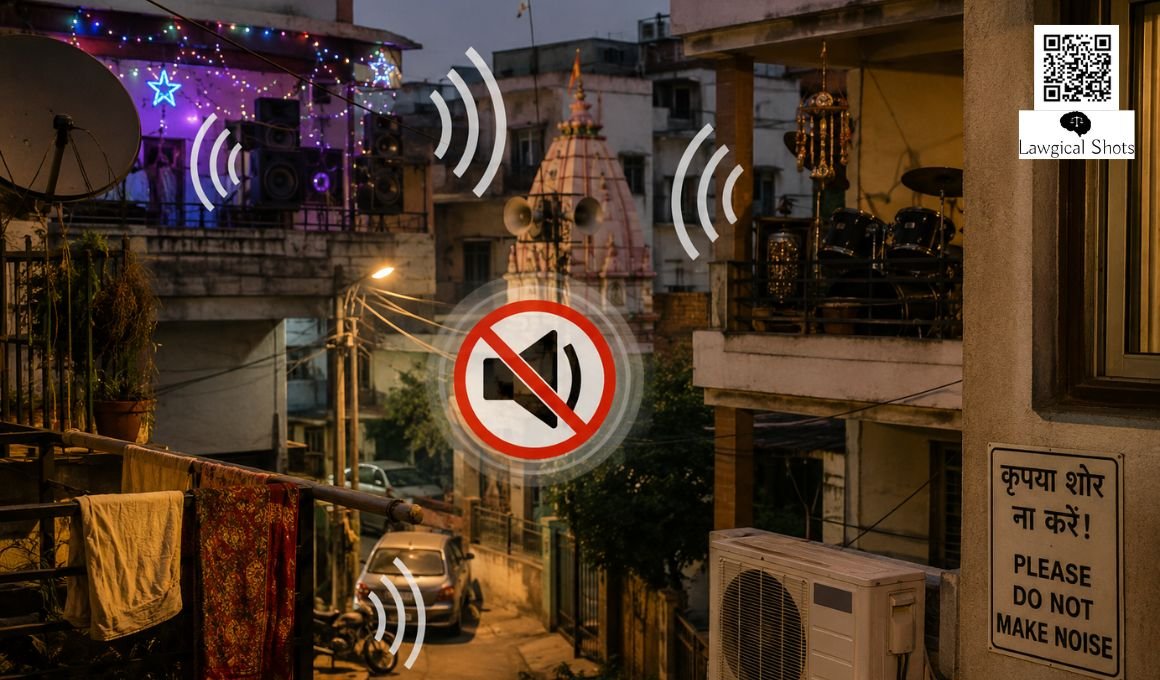

Noise from the neighbourhood, like loud music from night parties, drilling, construction activities, or musical instruments, can be stressful. This can be problematic for newborns, elderly, or patients. Regular sounds of the whistle of a pressure cooker, washing machine, light music, television, or shifting of furniture, cracking sound of opening and closing doors are normal, but when noise exceeds a threshold, it becomes a disturbance and leads to stress.
In this article, we will explore the meaning of noise surrounding us. If it is just a sound or disturbing noise capable of being complained of before law enforcement.
Standards of Noise Pollution
As per the The noise pollution(Regulation and Control) Rules, 2000, the following are the ambient noise standards in Decibels. Ambient noise means all background sounds present in the given area. It is a mix of natural as well as artificial sounds.
| Area | Day (6:00 AM to 10:00 PM) | Night (10:00PM to 6:00AM) |
| Industrial | 75 dB | 70 dB |
| Commercial | 65 dB | 55 dB |
| Residential | 55 dB | 45 dB |
| Silence Zone | 50 dB | 40 dB |
When noise from the neighbourhood turns nuisance?
Noise is a normal part of any area. Noise can be from household activities, pets, vegetable sellers,repair work, construction work,vehicles etc.When the noise from the neighbourhood exceeds the permissible limits, it becomes a nuisance. An occasional celebration like birthday, marriage, or any festival is a normal thing in the community. But repeated loud music at night, loud music, noise by shouting, use of loud speakers, crackers that interfere with sleep, frightens animals etc becomes a nuisance.
The Noise Pollution(Regulation and Control) Rules, 2000, provides for the penalty for whoever plays any music or uses any sound amplifiers, beats a drum or tom-tom or blows a horn either musical or pressure, or trumpet or beats or sounds any instrument, exhibits any mimetic, musical or other performances of a nature to 44raq crowds.
Public nuisance under the law
A noise can be a public nuisance to connect dots with the law against noisy neighbours in India. When the noise crosses ambient levels and turns disturbing to residents, street animals, it is a public nuisance.Section 270 of Bhartiya Nyaya Sanhita (formerly Section 268 of Indian Penal Code, 1860), it says “A person is guilty of a public nuisance who does any act or is guilty of an illegal omission which causes any common injury, danger or annoyance to the public or to the people in general who dwell or occupy property in the vicinity, or which must necessarily cause injury, obstruction, danger or annoyance to persons who may have occasion to use any public right but a common nuisance is not excused on the ground that it causes some convenience or advantage.”
So when a noise level exceeds a permissible ambient noise standard and causes injury, danger or annoyance becomes a public nuisance. Now let’s understand injury, danger, and annoyance one by one:
- Injury can be headaches, cervical pain, deafness, migraine, eye floaters, sleep challenge or difficulty sleeping thereby causing fatigue, anxiety, stress etc
- Danger can be not being able to listen to what the next person is saying which may result in any lost opportunity or accident.
- Annoyance can be difficulty in studying, infants crying, loss of peace, other similar and persistent circumstances.
How to measure noise and decide if it has crossed permissible ambient noise standards?
It can be done at two levels:
- Personal level: Use a sound level meter and check the noise in decibels. But don’t use mobile apps as they are not reliable sources.
- Authority level: Take the help of competent authority/pollution control to test it using their devices, which is way more reliable and holds value in the eye of law.
Steps for reporting noisy neighbours as per Law
- Record the noise for three or more consecutive days.
- Before initiating any complaint, an easy approach can be taken by talking about it with the concerned resident. Seek their feedback. If they don’t respond then go to the Resident Welfare Association (RWA) or any other body of your locality.
- Call police at 112 and go for Police mediation under Section 126 of Bhartiya Nagrik Suraksha Sanhita 2023
- The fastest forum for noise pollution complaints is National Green Tribunal (NGT). An online complaint can be filed easily and free of charges at greentribunal.gov.in through its e-filing portal.
- One also can make a complaint to the authority under the Noise Pollution(Regulation and Control) Rules, 2000. Here the “authority” means any authority or officer authorised by the Central Government, or as the case may be, the State Government in accordance with the laws in force and includes a District Magistrate, Police Commissioner, or any other officer designated for the maintenance of the ambient air quality standards in respect of noise under any law for the time being in force.
Conclusion
Living in the same building does not mean one has to tolerate any behaviour. Even a neighbourhood asserting to live like a family is not permitted to make other’s living conditions miserable. A noise reading of persistent sound exceeding the ambient standards is clearly a violation of the Noise Pollution(Regulation and Control) Rules 2000. If a noise amounts to a public nuisance is a separate legal question. If a noise violates the Rules it automatically makes the person guilty under Section 270 of Bhartiya Nyaya Sanhita, 2023. If this noise causes injury, danger, and annoyance to other people living then it may fall under the BNS. So before deciding the next action to be taken one has to see other factors like hourly duration, time length, frequency, impact, and who are more victimised like toddlers, school students, ill people, senior citizens, pets etc. A reading on a sound level meter is a regulatory breach while actual impact is the public nuisance.