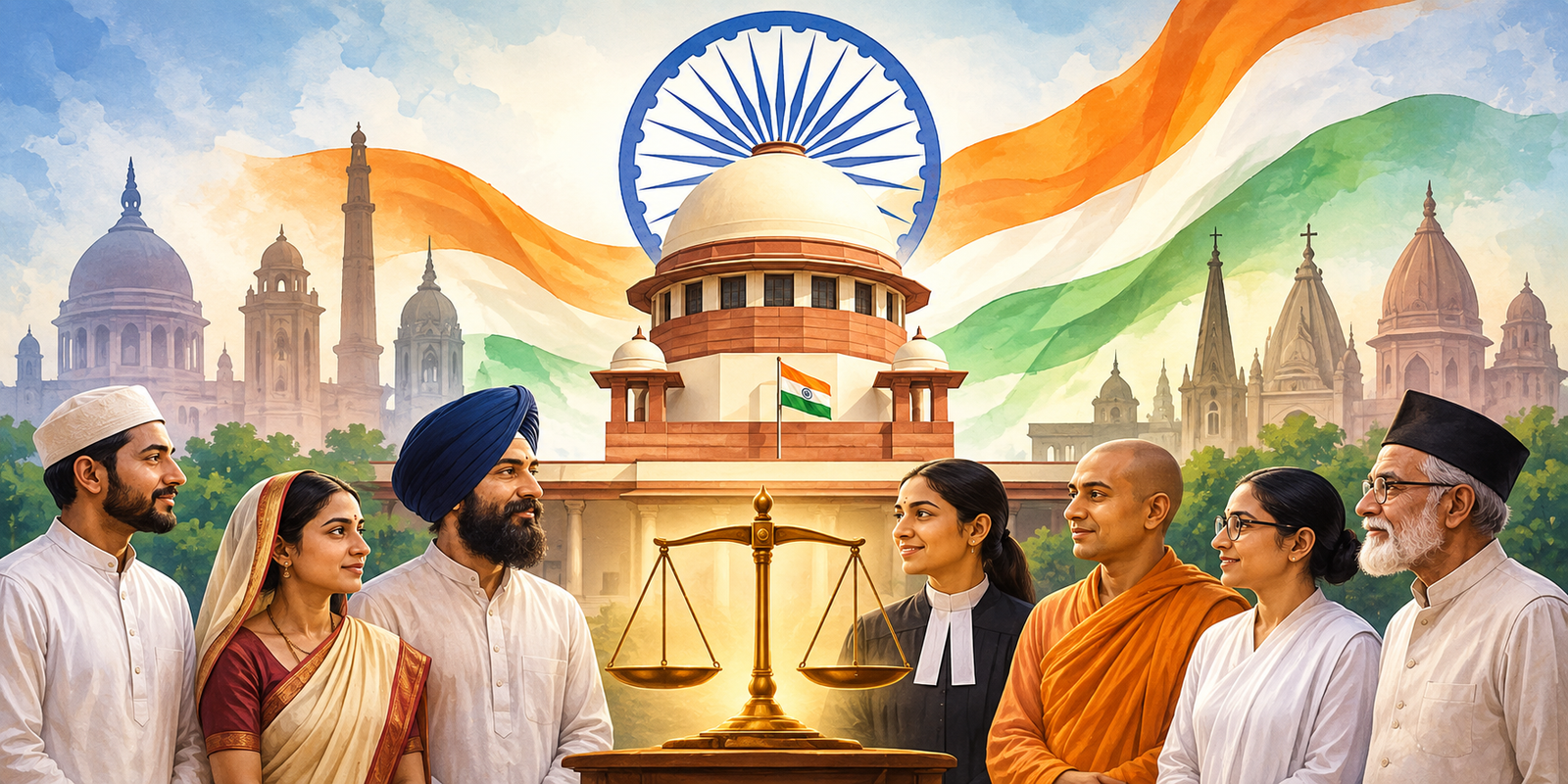

India is a land of disparity, be it culture, custom, religion, or languages, even landscape. India never had just one culture, custom , religion, or language. Various invasions from the Aryans to the Mughals, from the Portuguese to the British, further added culture, religion, and languages. In India, Secularism harmonizes diversity of religions across the territory with the State. The State recognises a religion as a private matter of its democracy. People can practice and spread awareness of their religion without any barrier from the State.
The present article highlights the meaning, concept,history, and challenges regarding Secularism in India.
Meaning and Concept of Secularism
Secularism is a political concept which defines the relationship of the State with the religion. “The State has no religion of its own”. Religion is a subjective thing as everyone has freedom to practice any religion. A citizen has a choice of his religion, the State cannot force anyone to choose a specific religion. The State will not interfere in the religious practices of its subjects. Individuals are free to profess, practice, and propagate religion. Propagation means discussing the tenets or ideals of that specific religion, but no one can force anyone to convert to a specific religion. There can be no discrimination on the basis of preference of religion.
State is a human association for the purpose of living in an order where law making, law adjudication, and execution of law is done. Hence, the state is not a spiritual or religious institution. Laws of the modern state are practical, made by people devoid of spiritual beliefs. Religion is separated from other realms of human existence like culture, politics, economics, social structure, festivals etc. Secularism is the practice of a way of living which has more individual’s unique, internal thoughts and perceptions based on feelings, life experiences and developing a scientific temperament. It is a philosophy which declines religious norms and focuses more on individual belief systems; however, it is not identical to atheism.
Indian Model of Secularism
The model of Secularism means how a country or a state or territory organizes and manifests the relationship between religion and itself. It also includes to what extent religion can control the behaviour of its people.
Secularism is a subjective concept. Different states have adopted different models of Secularism. The common objective of adopting any model of secularism is to prevent the abuse of religion, forced conversion, prevent crime in the name of religion, use of religion in governance.
The Indian model is based on “Sarv Dharm Sambhav”, which is equal respect and protection of all religions. It is different from the true meaning of secularism as the state is not denying religion to its subject. The State can also interfere for social reforms.
Historical Development
The term “Secular” is derived from the Late Latin word, “saecularis”, which means worldly, or pertaining to an age, and the classical Latin term “saeculum”, which means a long era, a century(80-110 years). George Jacob Holyoake was a newspaper editor who coined the term “secularism” in 1851. He differentiated it from “atheism” which was considered an anti-religious stigma.
Secularism and Constitution
Secularism is the fundamental principle under the Preamble to the Constitution. At the time of independence, India underwent a split and two dominions came into being: India and Pakistan. This division in the eyes of Dr. B. R. Ambedkar, was based on religion. He opposed the idea of declaring India a Secular state as this partition led to migration of several Muslim families from Independent India to Pakistan in 1947. But through other safeguards like social, economic, and political justice, fundamental rights, it sought a balance where all the religions were equally respected. Let’s dive deep into various parts of the Constitution which secure neutrality of the State in the matter of religion.
Preamble
The Preamble to the Constitution declares India a Sovereign, Socialist, Secular, Democratic republic. India secures to all its citizens justice, liberty, equality, and fraternity. Initially in 1947 India declared itself the only Sovereign, democratic republic. But in 1976 by Constitution (Forty Second) Amendment Act, 1976 ,were formally inserted “Socialist”, and “Secular”. India solemnly reaffirmed that it protects all religions and the State is a neutral actor in the practice of religion. Religion is a personal choice.
Right to Equality
Right to Equality is the core of Secularism as Secularism entails equality of all faiths and equal protection of all faiths. Right to Equality is enumerated under Article 14 which guarantees equality before the law and equal protection of all the laws.
Hence, Secularism under the Constitution of India has following characteristics:
- India does not have any official religion of its own, it is not dominated or influenced by any religion.
- Everyone can practice, profess and propagate the religion of their choice. However, this freedom is subject to public order, morality, and good health.
- No citizen can be discriminated against because of faith, beliefs, and religion.
- Focus is more on building harmony among people of various faiths and religions thereby promoting constitutional values such as equality, developing scientific temperament, religious tolerance, participation of every religion, sect, or faith in the development of India as unity.
- The state shall not discriminate against any citizen on the basis of religion.
- Government policies should not provide privilege to one religion over the other.
Under Article 15 the State cannot discriminate among citizens on the ground of religion, race, caste, sex, place of birth. However, the State can make special provisions for women and children.
Under Article 16 none of the citizens of India can be discriminated on religion, race, caste, sex, descent, place of birth, residence in any employment or office under the State.
Right to freedom of Religion
Article 25 paves way for freedom of conscience and the right freely to profess, practise and propagate religion for all persons. Persons means natural as well as juristic persons. Any group, association, or company has freedom of religion. This freedom is not absolute, it is subjected to public order, morality, and health.
Article 26 provides for management of religious affairs by every religious denomination or any section thereof. These are the rights:
(a) to establish and maintain institutions for religious and charitable purposes;
(b) to manage its own affairs in matters of religion;
(c) to own and acquire movable and immovable property; and
(d) to administer such property in accordance with law.
Article 27 says if any person promotes or maintains any particular religion, or religious denomination, they are free from the payment of taxes for this purpose.
Article 28 provides that if any educational institution is wholly maintained out of state funds then no religious instruction can be provided. Also, none of the individuals can be asked to participate in any religious instructions, or attend any religious worship imparted in any premises attached to that religious institution.
Cultural and Educational Rights
Article 29 under subclause 2 says that none of the citizens shall be stopped from seeking admission into any educational institution either directly maintained by the state or receiving some funds from the state on the grounds of religion, race, caste and language.
Article 30 protects the rights regarding education, establishment of educational institutions of the religious and linguistic minorities.
Directive Principle of State Policy
Article 44 provides for Uniform Civil code (UCC) as a Directive Principle of State Policy(DPSP) which is the establishment of civil laws applicable on all religions with regard to marriage & divorce, inheritance, adoption to establish a proper secular system.
Fundamental Duties
Article 51A(e) is the fundamental duty to promote harmony and brotherhood irrespective of religious, linguistic, regional, or sectional diversity.
Judicial Trends in India regarding Secularism
In His Holiness Keshavananda Bharati vs. State of Kerala (1973), Hon’ble Supreme Court discussed doctrine of basic structure of constitution, and held Secularism as the basic structure of the constitution and hence, it cannot be altered by the Parliament.
In R C Paudyal vs. Union of India(1993) it was held that Secularism essentially represents the nation’s commitment to treat persons of all faiths equally and without discrimination
In S R Bommai vs. Union of India (1994), Hon’ble Supreme Court held that Secularism is a basic feature of Indian Constitution.
In M Ismail Faruqui(Dr) vs. Union of India (1994) Hon’ble Supreme Court highlighted that “secularism” in India the State maintains no religion of its own, all persons are equally entitled to freedom of conscience along with the right to freely profess, practice, and propagate their chosen religion, and all citizens, regardless of their religious beliefs, enjoy equal freedoms and rights. But it does not mean that the secular character of India stops the state from taking actions into religious matters. The state can check any practice that may not be in larger public interest, impede growth and progress of India, or which violates the right to equality, dignity or other constitutional principles.
In essence, the concept of secularism represents one of the facets of the right to equality, intricately woven into the basic fabric that depicts the constitutional scheme’s pattern.
In Bijoe Emmanuel vs. state of Kerala (1987), Hon’ble Supreme Court said Secularism includes the right to hold distinct beliefs like the student from the Jehovah community did not sing the national anthem but stood respectfully. The state cannot coerce any citizen to force citizen into patriotic expressions.
In Ahmedabad St. Xavier’s College vs. State of Gujarat (1974), Hon’ble Supreme Court threw light on the relationship of state with religion that state is not against any religion. The state treats every religion equally and protects the educational rights of minorities.
Dr. Balram Singh vs. Union of India (2024) it was observed by the Hon’ble Supreme Court that India has developed its own understanding or conceptualization of Secularism. In India, there is no support towards any religion; and no penalty for its practice. India is a republic dedicated to eliminate all forms of disrespect or inequality towards religions.
Challenges and Way Forward
Secularism seeks to strengthen constitutionalism values of liberty, equality, and fraternity. Secularism must aim at impartial administration of the welfare state where a balance must be sought between religious practices and fundamental rights among people of different religions. Secularism must ensure interfaith respect and equality of opportunities. Minority rights and women rights shall be balanced with the right to equality among masses. It also discourages interference of politics in religion. Promotion of national unity by showing respect in the disparity of culture, custom, languages, territory, and religion.
Unlike in the West, India permits interference of the State in religious matters. This interference is sometimes used by political parties to gain votes. Votes are taken in the name of religion. Extreme spread of religious teachings also lead to tensions among different communities. They start competing in proving themselves better. This leads to going away from accepting the views of other cultures and religions.
There is a need for literacy by way of media and education concerning secularism to raise awareness. More focus should be on literacy regarding fundamental rights, human rights; this will help in identifying malefic practices and superstitions in the name of culture, custom, and religion. Development of scientific temperament is also crucial.
Conclusion
Secularism is the basic feature of the Indian Constitution. This protects religious freedom. It includes freedom to practice any religion or staying neutral in the matter of religion. No one can be forced to follow any religion as well as be criticized for not following any religion. Secularism in India is not strict separation of State from religion. It is based on equal protection of all religions. Secularism is separation of state affairs from religious institutions. A state which respects all religions may not bound to respect all the practices attached to the religion. If any practice connected to any religion is derogatory, oppressive, discriminatory, contrary to fundamental rights, human rights, the state may change it or abolish it for larger public interest or to secure a welfare state. Constitutional principles prevail over religion.