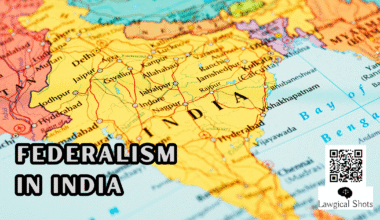
India has a federal system, which means the powers are shared between the Central Government and the State Governments. To exercise this power, Central Government runs through the Parliament. Just like that, State Government has a State legislature. States have Governors and one or two law-making houses. If a state has one House, it is called a unicameral legislature or single house legislature. If a state has two houses, it is called a bicameral legislature or double house legislature. The Prime Minister heads the Union Government, and similarly, the Chief Minister leads the State Government. Now, in this system, an important question comes up – Who can become a Chief Minister?
Let’s find out in this article.
Introduction
According to Article 168 of the Indian Constitution, the legislature of the State can either be unicameral (having one house) or bicameral (having two houses). In States with a unicameral legislature, there is only the Legislative Assembly (also known as the Vidhan Sabha). In contrast, states with a bicameral legislature have both the Legislative Assembly (Vidhan Sabha) and the Legislative Council (Vidhan Parishad). Article 163 of Constitution lays about the Council of Ministers of State, which is headed by the Chief Minister. Since the role of a Chief Minister is crucial in governance of a Stae, the eligibility for who can become a Chief Minister holds a lot of importance. The said Chief Minister holds the office during the pleasure of the President.
Process of Becoming Chief Minister in a State
Step 1: Check Eligibility Criteria (Article 173)
- Must be a citizen of India
- He/she must be a member of State Legislature
- Must be at least 25 years old for Legislative Assembly (Vidhan Sabha)
- Must be at least 30 years old for Legislative Council (Vidhan Parishad)
- Must take an oath/affirmation as per Third Schedule (before nomination)[1]
Step 2: File Nomination
– Candidate files nomination in a Vidhan Sabha Constituency.
– Can be done as a political party candidate or independent.[2]
Step 3: Election Process
– Elections are conducted by the Election Commission of India.
– Voting takes place under ‘First Past the Post’ system.
– Candidate receiving the highest number of votes is declared the winner.[3]
Step 4: Declaration as MLA
– Winning candidate becomes a Member of the Legislative Assembly (MLA).[4]
Step 5: Take Oath as MLA (Article 188)
– Before taking seat in Assembly, MLA must take oath under Article 188 as per Third Schedule.[5]
Step 6: Party with Majority Chooses its Leader
– In Vidhan Sabha, the majority party/coalition elects its leader.[6]
Step 7: Claim to Chief Ministership
– Chosen leader stakes claim to Governor for appointment as Chief Minister.
Step 8: Appointment by Governor (Article 164)
– Governor appoints the Chief Minister.
– Even a non-member can be appointed CM, but must get elected to State Legislature within 6 months.
Once a person decides to contest the election, they can file their nomination in a Vidhan Sabha (Legislative Assembly) constituency. The Election Commission of India then conducts elections in the State. After voting and counting of votes, the candidate who gets the highest number of votes is declared the winner. This method is known as the First Past the Post system.
The winning candidate becomes a Member of the Legislative Assembly (MLA), also known as a Vidhayak in Hindi. A candidate can contest the election either as a member of a political party or as an independent candidate.
After the elections, a session of the Vidhan Sabha is held. In this session, it is observed which political party or alliance has the majority of MLAs. The party with the most MLAs selects a leader from among them.
This chosen leader then goes to the Governor and presents a claim to become the Chief Minister.
It is not necessary for the Chief Minister to already be a member of the State Legislature at the time of appointment. However, they must get elected to either the Vidhan Sabha or the Vidhan Parishad (Legislative Council) within six months.
If the Governor is satisfied that the party or alliance has majority support in the Vidhan Sabha and the leader has the backing of most MLAs, the Governor appoints that leader as the Chief Minister.
Sometimes, if no single party gets a majority, a party can form a coalition with independent MLAs or other smaller parties to reach the required majority and then stake claim to form the government.
What Happens If No Party Gets Majority in the State?
In situations where no single political party secures a clear majority in the State Legislative Assembly, the process of selecting the Chief Minister becomes more complex.[7] The Governor plays an important role in such scenarios. Normally, the Governor first invites the leader of the single largest party to form the government and prove majority on the floor of the House.[8] If that leader fails to gain support, the Governor may call upon other parties or alliances that can provide evidence of majority support either through a post-poll coalition or letters of support from independent MLAs.[9] If no stable government can be formed, the Governor may recommend President’s Rule in the state, leading to re-elections.[10]
Case Study: Bihar’s Political Twist
In Bihar, Nitish Kumar was appointed as the Chief Minister after breaking the alliance with RJD and joining hands with the BJP. At that time, no single party had an absolute majority on its own. After forming a majority in the house, he proved his strength on the floor and continued as CM.
If no party gets a clear majority, the Governor can invite the single largest party to form the government. However, they must prove majority support on the floor of the House. If they fail, the Assembly may be dissolved, and re-elections may be called.[11]
Council of Ministers of State
Once the CM is appointed, the Governor appoints the Council of Ministers on the CM’s recommendation. This Council is collectively responsible to the Legislative Assembly. If it loses the confidence of the House, the government collapses.
As per Article 178, the Assembly must have a Speaker and a Deputy Speaker, elected from among the Assembly members. These officers conduct proceedings and maintain order in the house.
Why Legislative Council ( Vidhan Parishad) Has No Role in choosing Chief minister:
- The Council of Ministers (headed by the CM) is collectively responsible only to the Legislative Assembly, as per Article 164(2).
- The Legislative Council is a permanent body and mainly acts as a revising chamber, similar to the Rajya Sabha at the Centre.
- It cannot pass a no-confidence motion or decide the fate of the government.[12]
Can a Chief Minister Be from the Legislative Council (Upper House)? A Look at the Law and Reality
While the Constitution of India doesn’t say that a Chief Minister must be from the Legislative Assembly, in reality, that’s almost always the case. Most Chief Ministers are chosen from the Vidhan Sabha, or the lower house of the State Legislature, because that’s where the real power lies—especially when it comes to proving majority support.
But here’s the interesting part: it is legally possible for a person to become Chief Minister even if they are from the Legislative Council, which is the upper house of the state legislature. In fact, the Constitution allows the Governor to appoint anyone as Chief Minister, even if they are not a member of either house, as long as they get elected to one of the two houses within six months of taking office (Article 164(4)).
However, in actual political practice, Chief Ministers are almost always from the Legislative Assembly (lower house). Why? Because the Legislative Assembly is directly elected by the people and holds the power to pass confidence motions. Being an MLA (Member of Legislative Assembly) gives the Chief Minister democratic legitimacy and practical control in the Assembly.
That being said, there have been exceptions. A well-known example is Nitish Kumar, the long-serving Chief Minister of Bihar. He has held the post multiple times without contesting Assembly elections. Since 2005, he has chosen not to fight Vidhan Sabha elections at all, and instead entered the State Legislature through the Legislative Council (as an MLC). This allowed him to take the Chief Minister’s office while fulfilling the constitutional requirement by becoming a member of the Legislature within six months.
So, while the upper house route is rare, it’s not impossible. But most parties avoid it because it doesn’t send a strong message of direct public mandate which is crucial in Indian democracy.[13]
How the Governor Chooses the Chief Minister ?
According to the Constitution (Article 164), the Governor appoints the Chief Minister. It is generally accepted that the Governor’s discretion in appointing the Chief Minister should be guided on the following principles:
- If one party has clear majority, the Governor invites the leader of that party to become the Chief Minister.
- If a group of parties (called a pre-poll alliance) comes together before the election and wins majority, then the leader of that alliance is invited.
- If no one has majority, then the leader of the largest party may be invited to prove majority in the Assembly.
- If parties come together after the election (called a post-poll alliance), then the leader of that group may be asked to form the government.
If these steps are followed, it helps the Governor take a fair and clear decision, without creating any confusion or political conflict.[14]
Conclusion
In India, the Chief Minister is the head of a state government, just like the Prime Minister is the head at the national level. To become a Chief Minister, a person must first be elected as an MLA (Member of Legislative Assembly) or become a member of the state legislature within six months. The Governor appoints the Chief Minister, usually the leader of the party or alliance that has the most members in the Vidhan Sabha. Even though the Legislative Council exists in some states, it does not play a role in choosing the Chief Minister. While most Chief Ministers come from the lower house, a few have become CM from the upper house as well. The process shows how Indian democracy works both with rules and practical politics.
[1] [Harjit Singh v. Umrao Singh, AIR 1980 SC 701.
[2]R epresentation of the People Act, 1951, Sections 33 and 34.
[3] Representation of the People Act, 1951, Section 66.
[4] Indian Constitution Art.188.
[5] India Const. Art. 164, cl.1.
[6] India Const. Art. 164 (1) and (4).
[7] India Consti. art.164, cl.1.
[8] In Rameshwar Prasad v. Union of India, (2006) 2 SCC 1, the Supreme Court emphasized that the Governor must explore all options, including post-poll alliances, before recommending President’s Rule under Article 356.
[9] Sarkaria Commission Report (1988).
[10] President’s Rule under Article 356 can be imposed if no party or coalition can form a stable government and constitutional machinery fails in the state.
[11] Nitish Kumar SailsThrough Bihar Floor Test After Opposition Walks Out, NDTV (Feb. 12, 2024, 4:13 PM IST), https://www.ndtv.com/india-news/nitish-kumar-sails-through-bihar-floor-test-after-opposition-walks-out-5042943.
[12] India Const. Art.171.
[13] Nitish Kumar never contested a Vidhan Sabha election after 1985. During his stints as CM after 2005, he remained a Member of the Legislative Council. See: “Nitish Kumar: Bihar Assembly Election”, India Today, October 6, 2020 (last visted: July 31, 2025) https://www.indiatoday.in/elections/story/nitish-kumar-bihar-assembly-election-1728836-2020-10-06.
[14] Based on the Sarkaria Commission’s recommendations on Centre-State Relations and conventions followed in Indian constitutional practice. See also: S.R. Bommai v. Union of India, AIR 1994 SC 1918.
The answer to who can become a Chief Minister is brought in by our intern, Ms Chaitali Bhivgade. She has been assisting the team in bringing informational legal blogs.