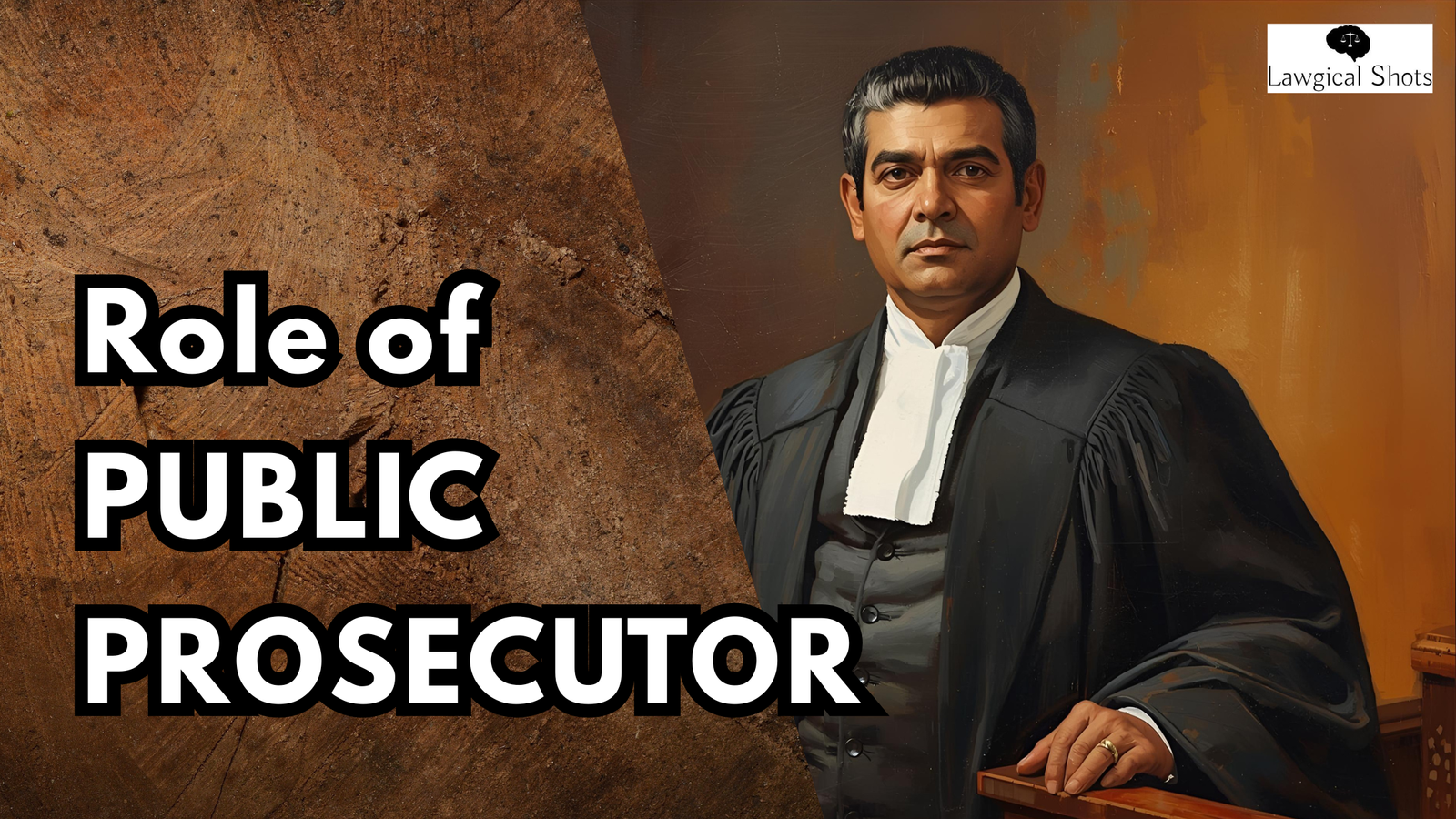

The Office of the Public Prosecutor holds a central role in the criminal justice system. A Public Prosecutor is not only the representative of the State but also an “Officer of the Court” whose duty is to assist the court and ensure that the justice delivery is fair. The main role of Public Prosecutor is to strike a balance between rights of the parties, with the fairness of justice delivery system. He/she acts as a pillar of the criminal justice administration. As a judge must be fair, so should a Public Prosecutor. He/she must be independent and impartial. Suppose he sees a victim in a very critical medical condition which was caused by the accused, so he must not be vengeful towards the accused or full of sympathy towards the victim.
Public Prosecutors are representatives of the State in a criminal trial, and their role is to ensure fairness during trial by studying the FIR and chargesheet, presenting evidence, examining witnesses, while prosecuting the accused, and not merely convicting the accused.
This article discusses the role of Public Prosecutor in ensuring the fairness, impartiality, administration of criminal justice by examining how the office of the Prosecutor safeguard the ends of justice while representing the State in the criminal proceedings.
Understanding the role of Public Prosecutor through history
The role of Public Prosecutor in India has always been a constant juggle against the doctrine of separation of powers. In ancient India around 1500 BC-800 AD, the role of Public Prosecutor was played by the King. There were no branches of Government. All the roles of legislation, executive, and justice delivery were discharged by the King alone with the help of his court’s officials. Criminal justice was based on “dharma”, i.e., duty or righteousness in thoughts, words, and actions. The Public Prosecutor was not an independent authority and was implicit in the form of King and his court’s officials collectively.
During the Medieval period when the Mughals started ruling India the legal system was separated from the King. Now the islamic laws, sharia, gained prominence. The administration of justice was carried out by “Quazi” (kaazi), who was akin to present day judges. They used to resolve legal disputes between the Court and the public, and among the people. There were hiring of some legal scholars to assist the people before the Quazi, those were called “vaqil”. Gradually those “vaqil” started performing the duties and functions of modern day Public Prosecutor.
Later came the Colonial period from 1700AD till 1947 when the seeds of present day Public Prosecutor were sown. During the Colonial period, principles of natural justice, English common law and codification of criminal laws were started. The purpose of the criminal laws were to provide a strong sense of security to people by defining which behaviour is an offence which is not. Procedural law was introduced so that there are fair and genuine crime reports, timely investigation, fair trial, and to prevent repeat offending by appropriate punishment. All this is where the role of the Public Prosecutor sets in.
Here we see that slowly, slowly, the duty to prosecute offenders was converted into the formal office of the Public Prosecutor. History shows the importance of the Public Prosecutor in assisting the court in awarding justice and ensuring that the laws are efficient. They are not discriminatory, and their interpretation does not favour or disfavour anyone. The Public Prosecutor works by the fundamental principles of justice so that no innocent person is punished and a guilty does not escape.
Legal Framework to depict Public Prosecutor’s Role
The prosecution during any trial before the Sessions court shall be conducted by the Public Prosecutor under Section 248 of the Bhartiya Nagrik Suraksha Sanhita, 2023. Under Section 338 of Bhartiya Nagrik Suraksha Sanhita, 2023 the Public Prosecutor or the Assistant Public Prosecutor do not require any written authority for inquiry, trial, or appeal for any case. Under Section 339 of the Bhartiya Nagrik Suraksha Sanhita, 2023 is basically conducted by the Public Prosecutor or the Assistant Public Prosecutor unless the court permits any other with some prescribed conditions.
Under Section 193(6) a Police Officer conducting the investigation of the case has to forward all the documents and statements recorded to the Public Prosecutor upon which the prosecution has to rely. Here, the Public Prosecutor scrutinizes the police report, examines the strength of the evidence, studies the statement of the witnesses, and finally prepares the prosecution case. He ensures that everything is up to the mark. He also offers revision of the charge-sheet to the investigating officer.
Important Law Commission reports on Prosecutor
154th Law Commission of India Report on The Code of Criminal Procedure (1996)
This report says that the Public Prosecutor are the ministers of justice whose only task is to assist the State in the justice administration. Public Prosecutors are not the representative of any party. Their task is to assist the Court by placing all the relevant documents, witnesses, reports, evidence, etc before the court. They must ensure that the victim has received fair justice and the accused has not escaped the punishment.
197th Law Commission of India Report on Public Prosecutors Appointments (2006)
This report highlights that The Prosecutor has a duty towards the State,the accused and to the court. The Prosecutor is at all times a minister of justice. A Public Prosecutor must not look to secure conviction as well as victory in the case.
Judgments on Role of Public Prosecutor in India
- Queen Empress vs. Durga ILR (1894-96) 16 All 84, Allahabad High Court separated the duty of the Public Prosecutor to conduct prosecution in fair manner, not securing convictions, only focussing on justice.
- In Mendichetty Ramakistiah vs. State of Andhra Pradesh (1959), the High Court of Andhra Pradesh said that the prosecution “ought not to be a persecution”. Persecution means harassing anyone continuously.The Public Prosecutor must be detached from the parties and fair while presenting the case.
- In Shiv Kumar vs. Hukam Chand and Another (1999) the Supreme Court affirms that the prosecution in the Sessions court must be conducted by the Public Prosecutor exclusively. Further, the Court highlighted that permitting the counsels other than Public Prosecutor may lead to biased prosecution and compromise the integrity of the judicial system.
- In State of Maharashtra vs. Surendra Gadling and Ors. (2019) the Supreme Court emphasised that the Public Prosecutor is not a part of the investigative agency. It is an independent statutory authority. He is expected to apply his mind independently before submitting the report to the court. He is not a post office or forwarding agency. He doesn’t have to always agree with the views of the investigating officer. The Public Prosecutor has the option to agree or disagree with the reasons given by the Investigating Officer.
- In Anees vs. State (NCT of Delhi), 2024, a three judge bench observed that the relation between the public prosecution Service and the judiciary are the very cornerstone of the criminal justice system. It means Prosecution is the most important part of the Court. Public Prosecutors hold the same place as that of a judge during the trial proceedings.
- Sovaran Singh Prajapati vs. State of Uttar Pradesh (2025), which discusses the fair-trial of accused, highlights the role of prosecutor by saying that in a criminal trial the burden to prove is always on the prosecution unless there is a law which shifts the burden on the accused. The Public Prosecutor is the officer of court, he has the responsibility of examining all the possible angles, collecting all relevant evidence, then presenting all evidence before the court.
- In Ashok vs. State of Uttar Pradesh (2024), the Supreme Court stated that if an accused cannot afford a defence counsel then it is upon the Public Prosecutor to point out to the court to provide the accused with legal aid. The responsibility is on the Public Prosecutor to ensure the fairness in trial by providing legal aid to the accused. Also, he must assist the court in framing questions to be put to the accused.
Conclusion
Overall, the role of the Public Prosecutor is to ensure the fair trial of the accused away from the clutches of the private counsels. His role is maintaining the integrity of the criminal justice system. Further, presence of the Public Prosecutor for the presentation of the victim also saves the victim from influence of the accused in case the accused is well off. Private counsel may be influenced by the elite class accused hence the presence of the law officer of the State saves the state and the sufferer from unfairness. Hence, the Public Prosecutor helps prevail justice over prejudice