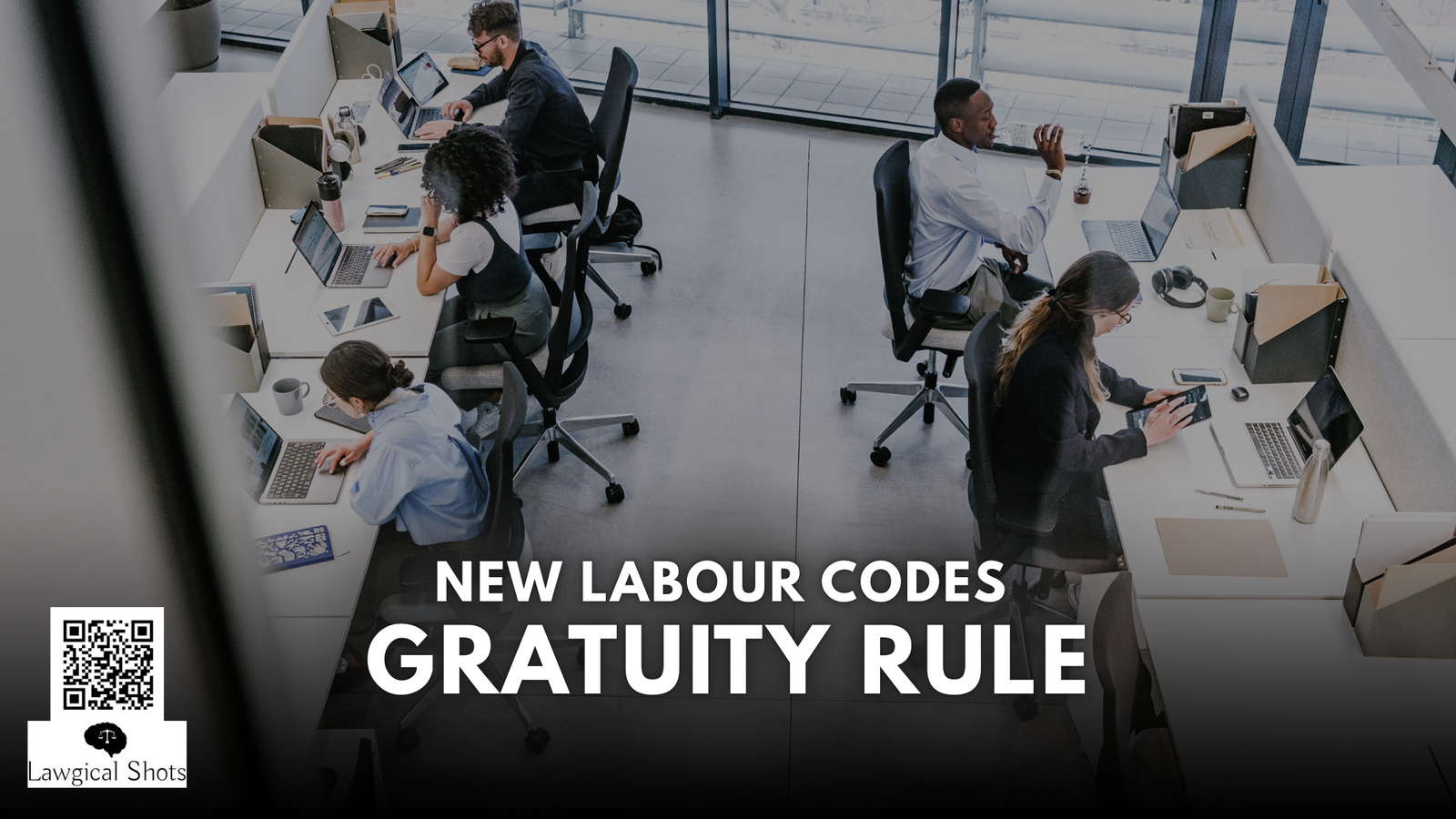

The Central Government on November 21, 2025 notified the implementation of New Labour Codes in India. With the issuance of this notification, everyone has been whispering about this New Labour Codes’ Gratuity Rule. What exactly is this noise all about? But before that, what exactly is gratuity? When is gratuity paid, and who is eligible for payment of gratuity? All such doubts have been addressed on this page. If you still end up having some doubts about the gratuity new rule or otherwise, please feel free to connect with us at lawgicalshots@gmail.com.
What is Gratuity in Labour Laws?
Gratuity can be understood as a lump-sum benefit paid by an employer to an employee as a gesture of appreciation for long-term service. It is a one-time payment an employer provides to an employee as a reward for long-term service.
When is Gratuity Paid?
As per the Code of Social Security, 2020, gratuity is payable on the following occasions:
- On employee’s superannuation; or
- On employee’s retirement or resignation;
- On employee’s death or disablement due to accident or disease; or
- On termination of employee’s contract period under fixed term employment; or
- On happening of any such event as may be notified by the Central Government
When employee is eligible for Gratuity?
As per Section 53 of the Code of Social Security, 2020, gratuity is payable on termination of employment after a fixed-term employee has rendered continuous service for 1 year. Earlier, the provision required continuous service for 5 years. But the new Labour Code gratuity rule has reduced the term from 5 years to 1 year. However, for other employees, the 5 year period of continuous service remains intact.
In case of death of the employee, the minimum service rule for gratuity does not apply. In such cases, gratuity is payable to the nominee of the deceased employee. If no one is nominated, then gratuity is payable to the deceased’s heirs. In case where nominee or heir is a minor, share of such minor has to be deposited with the competent authority notified by the appropriate Government. The said authority is required to invest the same for the benefit of such minor in a bank or other financial institution, as prescribed by the Government until the minor attains majority.
When Gratuity is not Paid?
The gratuity payable to any employee may be wholly or partially forfeited in the following cases:
- If the service was terminated for riotous or disorderly conduct or any other act of violence;
- If service was terminated for any act which constitutes an offence in the course of employment. It may involve moral turpitude.
Gratuity may be forfeited to the extent of damage or loss in following circumstances:
- Employee whose service was terminated for any act;
- Employee whose service was terminated for any wilful omission;
- Employee whose service was terminated for negligence causing damage/loss/destruction of property belonging to the employer.
Who is not eligible for Gratuity?
As mentioned in the explanation to provision for payment of gratuity, any employee of the Central or State Government is excluded. Any other person/employee who is governed by any other Act or rules for payment of gratuity are also excluded.
New Labour Codes Gratuity Rule
The whisper around New Labour Codes’ Gratuity Rule pertains to the reduction of service period from 5 years to 1 year. The information is true, but only for contractual employees. The notification focuses upon Fixed-Term Employees (FTE) to reduce the continuos period of service from 5 years to 1 year. In other words, fixed-term employees will become eligible for gratuity after one year of continuous service. It may be noted that the new gratuity rule is only applicable to contractual employees, and not the rest.
Conclusion
Based on the aforementioned discussion, what can be inferred is that gratuity is payable by an employer to appreciate the long and meritorious service of an employee. The 5 year continuous service requirement has been waived as per the recent notification. However, the New Labour Codes’ Gratuity Rule is not for all but only contractual employees. The Fixed-Term employees who were otherwise not eligible for gratuity due to short-term employment not reaching up to 5 years, will now be eligible for gratuity after completing 1 year of service.