
I was researching around War Crimes in International Law, as a topic for LLB semester examinations. That’s when a cousin sitting next to me asked – “Anna, why were the civilians attacked and killed during Russia Ukraine war instead of attacking the military bases? Why must the average citizen bear the consequences of the leaders’ choices? Were there no safeguards in place to shield the populace from the leaders’ crimes and brutal murders? Why is there no conversation about the people’s human rights?”
In the past, overpowering the enemy country was the simplest approach to resolve a conflict. The terms and conditions used to be enforced by the person who has more power than the other. There are many instances of conflicts between two or more countries that could have been resolved by straightforward discussions between their leaders. Thousands of lives could have been saved. But, human rights and war crimes were, and are treated as non-existent at the time. The armed forces and people are both attacked. Millions of citizens are slaughtered, raped, exploited as test subjects, etc.
This article explores the concept of crimes committed during wars. Let’s understand what is a war crime and the evolution of War Crimes in international law.
What is a War Crime?
War crimes are severe breaches of International Humanitarian Law rights (that occur during armed conflict and incur criminal penalties for the perpetrators. The Rome Statue of International Criminal Court and the Geneva Conventions (1994) codified these principles which include hostage-taking, deliberate death, torture, and assaulting civilians. These laws are applicable to both non-international and international armed conflicts.
In order to be accountable for a war crime, the individual harmed must be safeguarded as per the Geneva Conventions. The First, Second, and Third Geneva Conventions pertain to military personnel, whereas the Fourth Geneva Convention is relevant to civilians and “unlawful combatants.”
The following acts are war crimes under Rome Statute Article 8, like Wilful Killing, Torture or inhumane treatment etc. For example, torturing enemy soldiers to get the information is a serious violation of Geneva Convention.
Elements of War in International Laws
There are certain pre-requisites to establish a war crime.
- Firstly, there must be the happening of an armed conflict, whether domestic or international.
- Secondly, there must a close connection between the act and the conflict, closely in nexus with the hostilities.
- Third, the offender must have intentionally committed the act, knowing that it deliberately violates the international humanitarian law.
Article 8 of Rome Statute
Prosecution for war crimes requires the existence of an armed conflict and that the offender was aware of the conflict (ICC, Elements of Crimes, § 8).
In the context of command responsibility, the International Criminal Court (ICC) will use an “overall control test,” which necessitates that the defendant has “a role in coordinating, planning or organizing the actions of the military group, in addition to funding, preparing and arming the group or providing operational support to it”
Historical Development of War Crimes under International Law
In Ancient times, war crimes were governed by ancient texts and Chinese Strategies, which prioritised protection of non-combatants, which later extended to prohibition against killing children, Women and religious figures.
In 1869, during the American Civil war, The Lieber Code laid down the foundation for significant codification of customary international law focused upon regulating behaviour during warfare.
The Hague Conventions of 1869 and 1907 established the modern laws of war by addressing the Protections of civilians, treatment of prisoners of war and Prohibitions on specific weapons.
In Nuremberg trail, where judges from many countries prosecuted German officials and soldiers for war crimes, crimes against humanity and crimes against Peace during World War – II. Many were sentenced to death, while others received prison terms.
Similarly, In Tokyo Trial, the Japanese leaders and military personnel were prosecuted for crimes against Peace, conventional war crimes and crimes against humanity during World War-II and awarded death sentence.
The Nuremberg Code and the Tokyo trial established the concept of making the individuals criminally responsible for war crimes, not just the states.
The Geneva Convention of 1949 established the concept of “grave breaches” regime, which mandated the states to look for and punish those who commit grave violations during international armed conflicts such as willful killing, torture, and unlawful imprisonment which is further supported by 1977 Additional Protocols by extending the protection to non-international armed conflicts including civil wars.
Enforcement Mechanisms
During 1990s, Ad hoc Tribunals were established by United Nations Security Council (UNSC) for the International Criminal Tribunal for Yugoslavia (ICTY) and International Criminal Tribunal for Rwanda which cultured the application of war crimes to Internal Conflicts by establishing significant precedent.
The Rome Statue established the Permanent International Criminal Court in 1998, which codified the list of war crimes in international law. This was to ensure that the most serious crimes such as genocide, crimes against humanity and war crimes do not go unpunished by explicitly highlighting on sexual violence and gender-based violence as a war crime.
International Criminal Court prosecutes individuals for the crimes which they committed and defined under Rome Statue committed in both domestic and international armed conflict.
Contemporary Examples of War Crimes
Attacks on Civilians and Escalation (America-Iran-Israel Conflict)
Iran, Israel, and its neighbouring states are in a state of conflict for more than a month (Since March 2026). Following Venezuela attack, America’s role in the ongoing conflict cannot be denied. The most concerned aspect of the ongoing disturbance is the attack of girl’s school which killed numerous innocent souls in Iran. That’s not just one example, and Iran is not the only victim. The neighbouring states also have civilians being attacked.
Intentional Attacks on Civilians (Russia – Ukraine War)
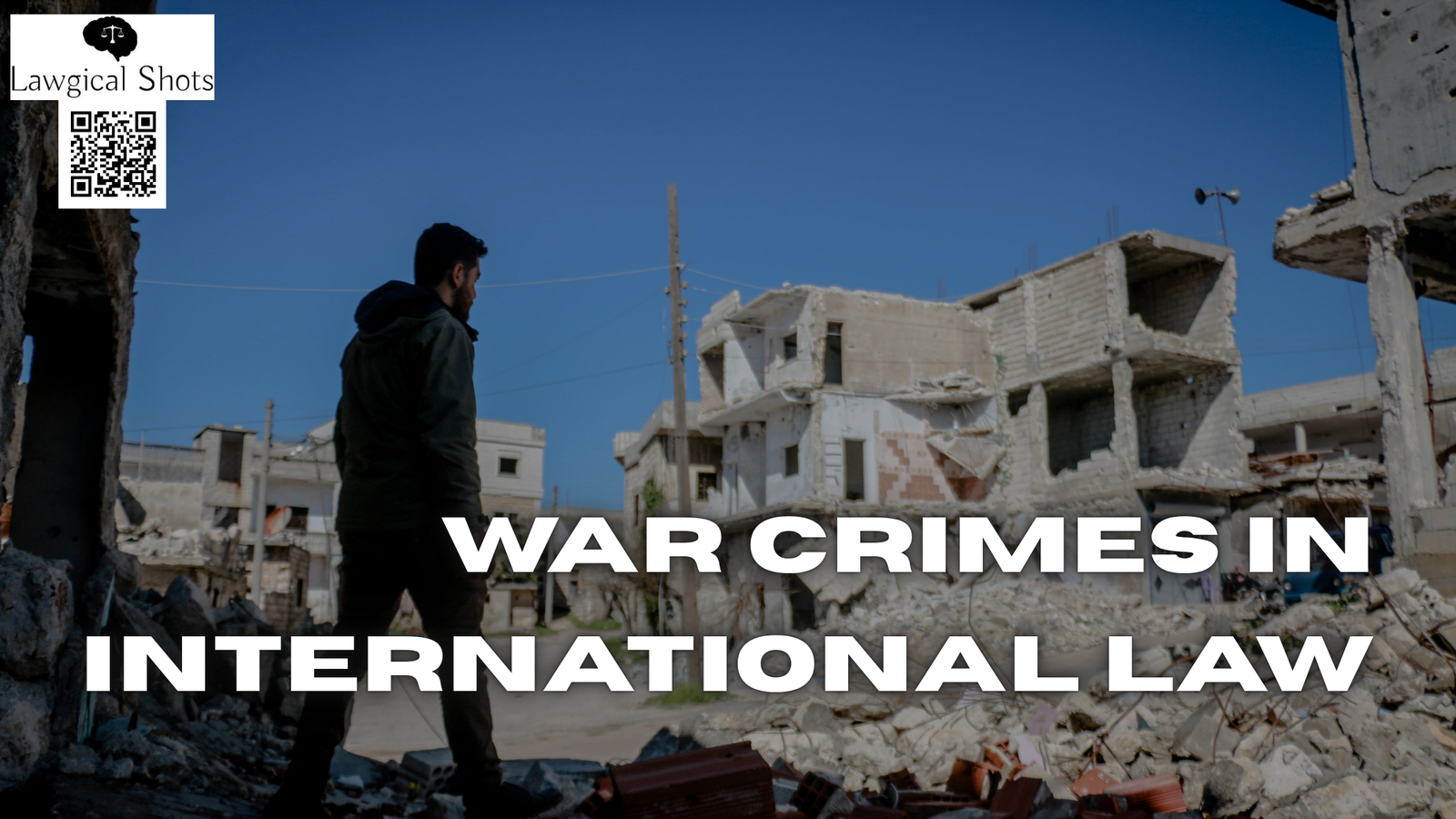
Recent ongoing global conflicts like Russia- Ukraine War have brought the war crimes into picture. During the Russian – Ukraine War (Going on since 2022) , there were allegations of War crimes committed with deliberate attacks on civilians and infrastructure by targeting schools, civilians, children and cultural property which violates the international humanitarian law and the Rome Statue.
Sexual Violence and Attack on Non-Combatants in Sudan (2023)
The violent clash between Sudanese Armed Forces (SAF) and the Rapid Support Forces (RSF) resulted in deliberate attacks on civilians, obstruction of humanitarian aid and destruction of residence which amounts to violation of Geneva Coventions by targeting non-combatants. In addition to these, there have been alarming accounts of sexual violence and extra judicial killings which amounts to violation of Rome Statue of International Criminal Court by falling within the scope of War crimes in International law.
Mass Killings of Rohingyas in 2017
The ill treatment and mass killing of Rohingyas in Myanmar is a clear contemporary example of war crimes under the International humanitarian law. In 2017, the Myanmar military carried out attacks in Rakhine involving sexual violence, sexual violence and coercing thousands to run away to Bangladesh. The act violates Geneva Convention, as it involves inhumane treatment on civilians. This matter is under the scrutiny before the ICC as it falls under the scope of war crimes of International Law.
International War Crimes: Major Challenges
- Selective Justice: ICC has faced criticism and perceived inability to hold powerful nations accountable for war crimes in international law. For example, during Syrian Civilian War, repeated votes by blocking referrals to UNSC clearly exhibited how political interests override justice.
- Jurisdictional Challenges: Non-party states and super powers such as USA, China and Russia have not enforced the Rome statue, which limits the global enforcement for offenders.
- Political Constraints and Weak Enforcement: ICC relies on states to execute arrest and access evidence. Lack of political will and sovereignty impedes the investigation and prosecutions.
- Collection of Evidence: Collecting reliable evidence in war zones is extremely difficult. Active conflicts, tampered evidence and fear among the witness delays investigation. Cases like Rohingya shows how incomplete evidence impedes prosecution efforts.
- Proving Commanding Responsibility: Linking atrocities of Political leaders and military actions requires substantial evidence which is extremely difficult to find in active war zones.
- Definition and Legal Ambiguities: It always remains controversial while distinguishing lawful military action and war crimes in international law. Modern conflicts fall outside the traditional definition of international war crimes, mainly in emerging areas like cyber warfare, non-state actors, terrorism etc.
Conclusion
War may be inevitable, but the suffering it causes can and must be limited. War crimes are severe breaches of international law, which demands strict accountability. Although several legal mechanisms exist, it depends upon political will of the states and global cooperation. Therefore, the global community must move beyond the mere condemnation and take concrete steps for peace, justice and human dignity in the international system.