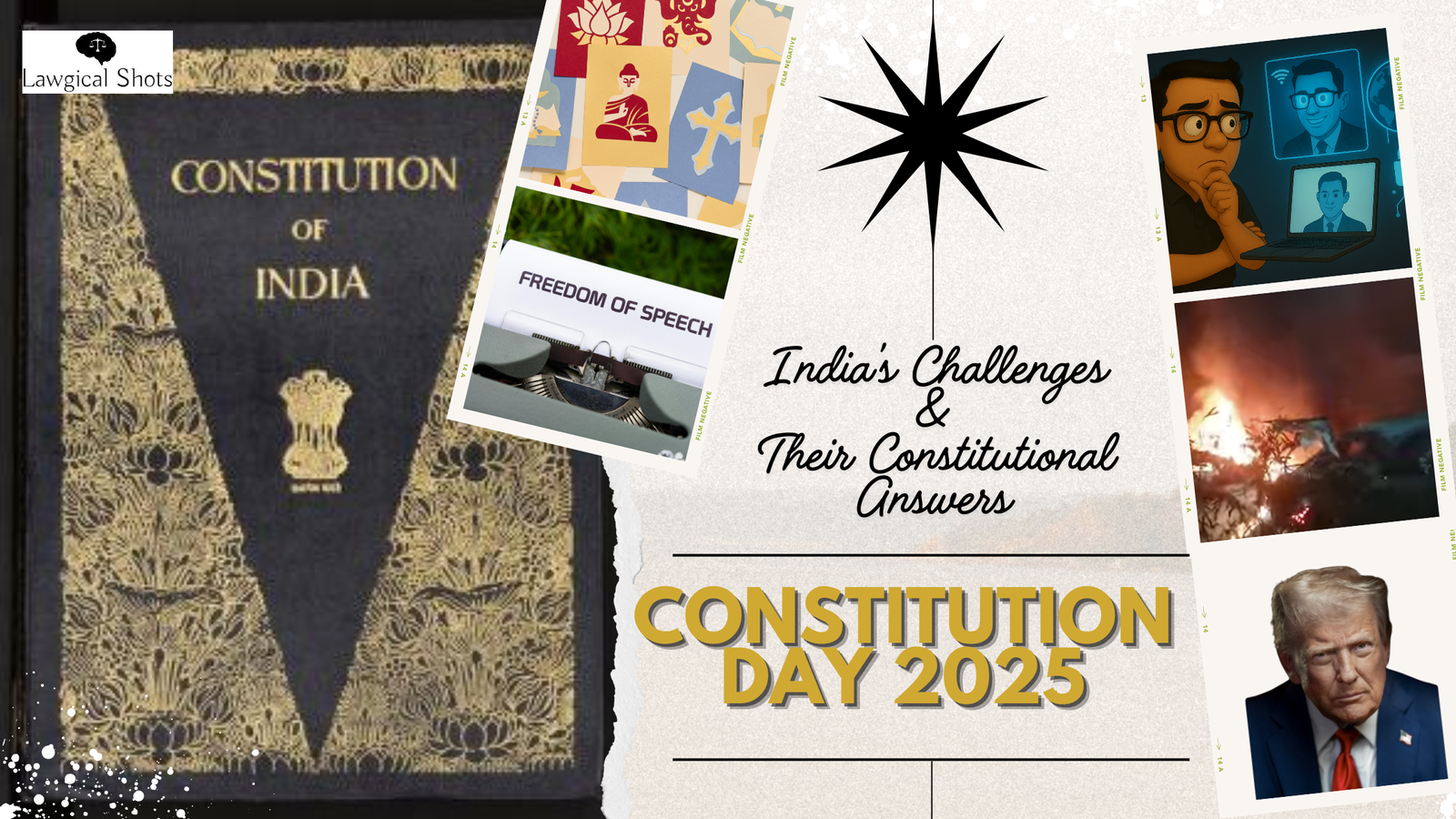

India is celebrating 75 years of its foundational law, with the Constitution Day 2025. It all started on November 26, 1949 when some part of the newly drafted Constitution of India came into force. The whole of it was enforced on January 26, 1950, celebrated every year as Republic Day. Our Constitution is termed a “live document” because it tends to change with time. It has witnessed several challenges, and helped the nation overcome all of them. Present day India is also facing some constant challenges, and the Constitution of India still holds the answers. On this auspicious event of Constitution Day, let us scan those challenges and its Constitutional response.
Constitution Day 2025
Today, it’s November 26, 2025, and the day is very special. Why? Because it marks 75 years of the Constitution in charge. As mentioned earlier, the Constituent Assembly adopted the Constitution of India on November 26, 1949. A few provisions of the same came into force on the very day. Since then, India has celebrated this occasion as Constitution Day.
India’s Challenges and their Constitutional answers
Being a “grundnorm”, or the foundational law in India, the Constitution seeks to have almost all the basic answers. If any law sets a tone contrary to constitutional regime, it is bound to be struck down. Thus, we think Constitution Day 2025 is the best day to look at present day challenges, to scan their solutions through our Constitution. Let’s go one by one.
- Environmental Degradation
Speedy deterioration of the environment in India is a gearing problem. The biggest challenge posed for now is the extreme air pollution in Delhi-NCR. The Supreme Court recognizes the right to clean environment as a fundamental right Article 21 of the Constitution. Clean air is a fundamental right and yet we are not able to achieve anything in this emergency situation. The Constitution brings an answer, environmental laws pose the solution, and it is for authorities to act in a timely manner. It is about the right to life of the people.
It is high time Constitution Day 2025 comes as a reminder that all the organisms deserve a clean environment. The duty comes upon us humans to uphold everyone’s welfare.
It is true that the Article 19 (1)(a) of the Constitution grants the freedom of speech and expression to the people. However, recent trends show some misuse of this freedom. Some of us assume that since we have free speech, we can say anything, with no boundaries. The Constitution of India has set some boundaries in this regard, which can even send them jail. Article 19 (2) puts some reasonable restrictions on the right to speech, such as defamation. Spreading hate in the name of religion, caste, or any kind of discrimination is prohibited under the Constitution.
- Threats to Freedom of Speech
While on one hand hate speech is a problem, the right to free speech and expression has faced allegations of suppression in recent years. Paid media and biased reporting to hide real facts and circumstances is a serious allegation. The Constitution of India extends the right to free speech under Article 19(1)(a) to the Press. The Supreme Court judgments on free Press further empower media houses to keep the people informed.
- Gender Rights
In India, patriarchal practices have reflected upon women being suppressed for years. In recent times, there have been cases like Atul Subhash where men faced the wrath of women centric laws. The Constitution of India seeks the right to equality both for men and women. This also means a gender neutral approach. However, there is another fundamental right which empowers the State to make special laws for women and others. Now, it is up to the authorities to make sure that laws made for the welfare of one side are not misused to weigh upon the other side.
- Digital Arrest
Though the government and other authorities have been making efforts to spread awareness, the numbers of digital arrests so far are alarming. It is yet another type of cyber crimes which people confuse with real arrest. It may be noted that the Constitution of India gives certain rights to accused persons. When arrested, you do not need to pay fines or anything but have the right to consultation with your advocate. On the contrary, scammers do not give any such option during digital arrest and people are forced into paying huge amounts to the scammers in the name of digital arrest. Please note that awareness is the key to fight against any such digital scams, and the Constitution also supports people’s rights.
- External Pressure
This year posed some international challenges on us as Trump tariffs made the headlines. The United States of America and the Trump Administration played a tariff game against India as a penalty for oil trade with Russia. The Constitution of India declares India a sovereign country. India is not answerable for any business to any super power. Whoever the Government of India decides to carry out trade with, they can!
- Terrorism
This year, India faced some terrible threats with kilos of explosives, one big explosive attack, and another targeted attack at Pahalgam. The Constitution of India upholds national security. When external forces are a threat for India, the Constitution empowers the Government to make appropriate laws, or even declare an emergency to deal with the situation. Terrorism is not an attack against a specific nation or its sovereignty, but a violation of human rights.
- Religious Polarisation and Terrorism
Until now, some groups used to connect terrorism with a particular religion. The recent terrorist attack in Pahalgam, Kashmir was not just an attack against humanity but religion as well. Pahalgam terror attack was nothing short of terrorism under the garb of religious discrimination. Even politicians play the religion card to divide and rule. Religious polarisation, though very much persistent in Indian polity, is a dangerous encouragement. It must not be forgotten that the Constitution of India gives people the right to religion. Discrimination on the basis of religion is not tolerated.
- Cyber Privacy
With evolving technology, several offences committed online are coming into light. The provisions of the Information Technology Act, 2000 are wide enough to cover up any violations. Invading people’s privacy is yet another weapon, which has become more convenient with advancements in the field of Artificial Intelligence. Deepfakes and media made with AI tools have become a problem, affecting people’s privacy. The Supreme Court has already recognized privacy as a fundamental right under Constitution of India. Every person has the right to spend a dignified life, and control over privacy empowers that right. Any kind of invasion of privacy is a direct violation of a person’s right to life.
- Linguistic Diversity
India is recognized worldwide as a diverse nation, for the variety of religions, cultures, languages across its territory. However, the recent picture is horrifying when people are being beaten, losing their lives just because they speak a certain language, or cannot speak a regional language. This is definitely about the Hindi language controversy and the Constitution does not command what’s happening. Hindi and English continue to be used for official purposes as laid under the Constitution. Those seeking to create friction in the name of language should know that the Constitution empowers our linguistic diversity, not weakens.
Conclusion
Based on the 10 pointers discussed above, it reflects upon the various challenges faced by us Indians. This Constitution Day 2025 is a reminder that the Constitution Makers have proposed solutions for almost all kinds of challenges our nation faces. It is up to those in power and the rest of us to understand the situation and apply constitutional directives.