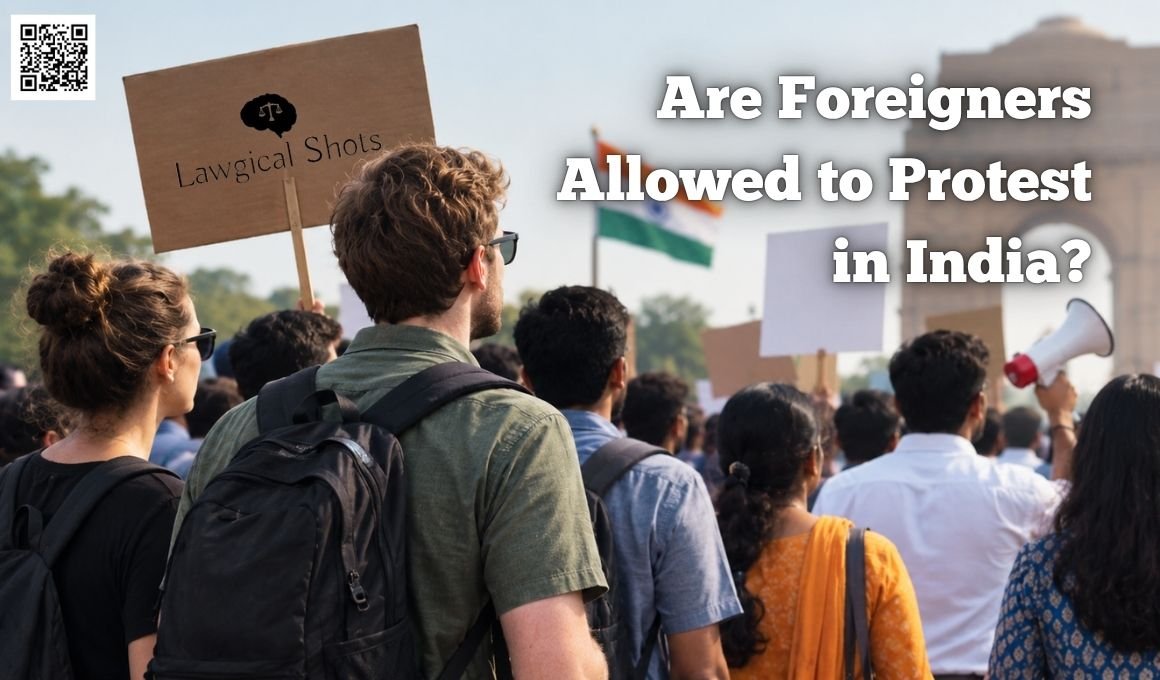

Protests are a familiar part of Indian public life, from farmers’ agitations to student demonstrations. But what happens when a foreign national, whether a tourist, student, researcher or expatriate, joins one? Are foreigners allowed to protest in India? The short answer is that foreigners are not entitled to the constitutional right to protest, and taking part in political demonstrations can put their visa, stay and liberty at risk.
This article explains the constitutional position, the visa and immigration rules, the position of NRIs and OCI cardholders, and the consequences a foreign national may face.
Are Foreigners Allowed to Protest in India? The Short Answer
There is no blanket statute that says “foreigners shall not protest.” The position emerges from the interaction of three things:
- The Constitution gives the freedom of speech and the right to assemble peacefully only to citizens.
- A foreign national enters and stays in India on a visa with conditions, and political activity is generally not what the visa is granted for.
- The Central Government has wide powers to regulate, restrict and remove foreigners.
In practice, a foreigner who joins a protest in India is acting without constitutional protection and may be treated as having violated visa conditions.
Constitutional Provisions on Right to Protest
Article 19: Rights Reserved for Citizens
Article 19(1) guarantees citizens the freedom of speech and expression (Article 19(1)(a)), the right to assemble peaceably and without arms (Article 19(1)(b)) and the right to form associations or unions (Article 19(1)(c)). The Article is addressed to “all citizens.” Foreign nationals cannot invoke it.
These rights are also subject to reasonable restrictions. Article 19(2) allows restrictions on speech in the interests of sovereignty and integrity of India, security of the State, public order and other listed grounds, while Article 19(3) allows restrictions on the right to assemble in the interests of sovereignty, integrity and public order.
Articles 14 and 21: Rights Available to Every Person
Not every constitutional protection is limited to citizens. Article 14 (equality before the law) and Article 21 (protection of life and personal liberty) apply to “any person” and “no person,” which includes foreigners. In National Human Rights Commission v. State of Arunachal Pradesh (1996), the Supreme Court held that the State must protect the life and liberty of non-citizens within its territory.
So a foreigner cannot claim a right to protest, but cannot be arrested, detained or treated arbitrarily outside the procedure established by law either.
How the Supreme Court Has Treated Foreigners’ Rights
Several judgments shape this area:
- Hans Muller of Nuremberg v. Superintendent, Presidency Jail, Calcutta (1955): The Supreme Court held that the Central Government’s power to expel foreigners from India is absolute and unfettered.
- Louis De Raedt v. Union of India (1991): The Court held that a foreigner’s fundamental rights are essentially confined to Article 21 and that a foreigner has no fundamental right to reside and settle in India.
- Ramlila Maidan Incident, In re (2012): The Court recognised that the right to assemble peaceably and protest is a fundamental right of citizens, though subject to reasonable restrictions.
- Mazdoor Kisan Shakti Sangathan v. Union of India (2018): The Court reiterated that peaceful protest is a protected democratic right and that protest spaces must be regulated in a balanced manner.
- Amit Sahni v. Commissioner of Police (2020): The Court observed that the right to protest does not permit indefinite occupation of public roads.
Taken together, these decisions protect protest as a citizens’ right while leaving the State wide discretion over the presence of foreigners.
Visa Conditions and the Immigration and Foreigners Act, 2025
The New Legal Framework
The Immigration and Foreigners Act, 2025 came into force on 1 September 2025. It replaced the Foreigners Act, 1946, the Registration of Foreigners Act, 1939, the Passport (Entry into India) Act, 1920 and the Immigration (Carriers’ Liability) Act, 2000.
The Act requires foreigners to enter and stay on a valid passport or travel document and visa, to register with the Registration Officer, and to comply with the conditions of their visa. It also empowers the Government to restrict the movement or residence of foreigners and to control places frequented by them.
Penalty for Violating Visa Conditions
Under Section 23 of the Act, a foreigner who overstays, stays without valid documents, or does any act in violation of the conditions of the visa is punishable with imprisonment of up to three years, or a fine of up to ₹3 lakh, or both. The Act also provides for abetment, compounding of offences and powers of arrest and enforcement.
The Act does not name “protest” as an offence. The exposure arises when participation in a demonstration, or in political activity more broadly, is held to breach the purpose or conditions of the visa, for example a tourist, student or business visa.
Removal from India
Apart from criminal liability, the Government can order a foreigner to leave India, and visas can be cancelled or future entry denied. Following the 2019–2020 anti-CAA demonstrations, there were media reports of foreign students and visitors being asked to leave the country after being seen at protests. Whether any particular departure was formally a deportation or a request to leave depends on the facts, but the episode shows how readily the State uses these powers.
Other Laws That Apply at a Protest
Whether a person is a citizen or a foreigner, the general criminal law applies to everyone present at a demonstration:
- Unlawful assembly and rioting: Sections 189 to 191 of the Bharatiya Nyaya Sanhita, 2023.
- Prohibitory orders: Section 163 of the Bharatiya Nagarik Suraksha Sanhita, 2023 (the successor to Section 144 of the CrPC) lets a magistrate bar the assembly of people in an area to prevent disturbance.
- State and local rules: Police permissions for rallies, designated protest sites and noise restrictions.
A foreigner who also violates these laws faces criminal proceedings in addition to immigration consequences.
Can NRI Protest in India?
This is a frequent question, and the answer is very different from the position of foreign nationals. The confusion arises because people use “NRI” loosely for anyone of Indian origin living abroad.
NRIs Are Citizens
A Non-Resident Indian (NRI) is an Indian citizen who lives outside India. Citizenship is not lost by residing abroad. So can an NRI protest in India? Yes. An NRI retains the rights under Article 19(1)(a), (b) and (c) and can speak, assemble peacefully and protest, subject to the same reasonable restrictions and laws that apply to every other citizen. They need no visa to be in India.
PIOs and OCI Cardholders Are Not NRIs
Persons of Indian Origin (PIOs) and Overseas Citizens of India (OCI) cardholders are foreign nationals with a special relationship with India. They do not hold Indian citizenship and therefore have no Article 19 rights. The OCI card gives a lifelong multiple-entry visa and parity with NRIs in certain economic and educational matters, but not political rights.
OCI cardholders also face conditions. Under Ministry of Home Affairs notifications, certain activities, such as missionary work, journalism, research and mountaineering, require special permission or permits. Section 7D of the Citizenship Act, 1955 allows the Central Government to cancel OCI registration on specified grounds, including where it is necessary in the interests of the sovereignty and security of India, or where the person has shown disaffection towards the Constitution. An OCI cardholder who joins protests therefore carries a real risk of being blacklisted or having the card cancelled.
Quick Comparison
| Category | Legal status | Right to protest under Article 19? | Key risk |
|---|---|---|---|
| Indian citizen resident in India | Citizen | Yes, subject to reasonable restrictions | Criminal law, prohibitory orders |
| NRI | Citizen living abroad | Yes, subject to reasonable restrictions | Criminal law, prohibitory orders |
| OCI cardholder | Foreign national | No | Cancellation of OCI, blacklisting, removal |
| Foreign tourist, student, worker | Foreign national | No | Visa breach, penalty under Section 23, removal |
Can Foreigners Express Views Online or Attend Other Events?
Similar to protest, there is no constitutional entitlement, and the real risk lies in visa terms and in how authorities characterise the conduct. Attending a public lecture, a cultural event or a peaceful vigil purely as an observer is very different from leading or organising a political agitation. Authorities have generally been far more sensitive to the latter. Foreigners who are unsure should check the specific conditions of their visa with the Foreigners Regional Registration Office (FRRO) or a qualified immigration lawyer before participating.