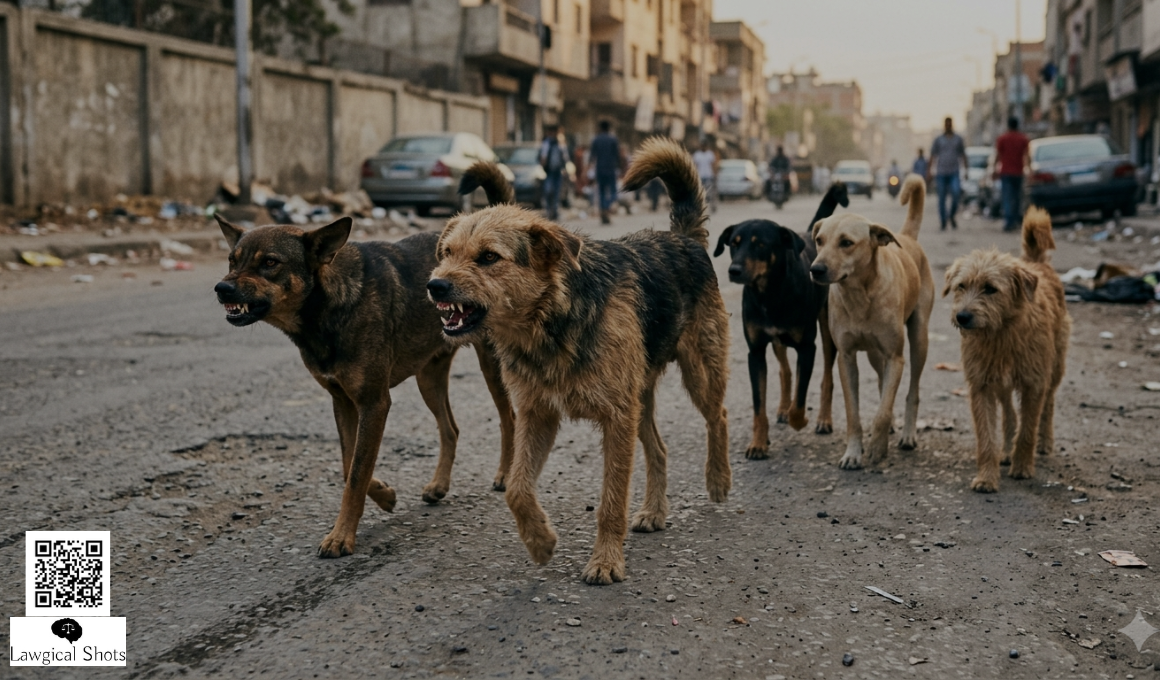

The recent stray dog judgment once again demonstrates the expanding scope of Article 21 of the Constitution. While animal welfare remains an important constitutional and statutory obligation, the Supreme Court emphasized that citizens too have a right to live with dignity, move freely and access to public spaces without fear of attacks.
The stray dog verdict highlights an important constitutional balance: compassion towards animals cannot ignore public safety and public safety cannot justify cruelty. The real concern perhaps lies in administrative failure: inadequate sterilization programs, poor implementation of Animal Birth Control Rules, lack of shelters and ineffective municipal action.
Background of Stray Dogs Case
Last year in July, a Bench of Supreme Court comprising Justice JB Pardiwala and Justice R Mahadevan took suo motu cognizance of a news article titled ‘City Hounded by Strays, Kids Pay Price’ regarding the death of a child allegedly due to a dog bite. Accordingly, the bench passed certain directions that all stray dogs in the National Capital must be picked up and confined to dog shelter, following which there was a lot of outrage in the public. Then the matter was referred to a three-judge bench comprising Justice Vikram Nath, Justice Sandeep Mehta and Justice NV Anjaria. The three-judge bench later modified the directions of the two-judge bench and held that dogs must be released after vaccination and sterilization. The matter was then expanded to PAN India movement and accordingly various directions were issued to the Jurisdictional municipal Bodies/ Authorities.
Subsequently, various organizations, associations and the Animal Welfare Board has filed Applications seeking modification, clarification, vacation, recall and or stay of the earlier directions issued vide order dated 7th November 2025, particularly those pertaining to removal of stray dog from institutional areas and prohibition on their re-release at the same locations and alleged that directions are against the Animal Control Rules Act,2023, also challenging the Standard Operating Procedure issued by the Animal Welfare Board of India.
Supreme Court Stray Dog Judgment
While considering the interlocutory applications seeking modifications/clarification and challenge to SOP, the Supreme Court also considered the status/compliance reports filed by the various State and Union Territories pursuant to its earlier directions, upon examining the same the court rejected the applications and expressed serious concern over the failure of state authorities and local bodies while discharging their duty of protecting people’s life from stray dog attacks.
The Court did a detailed interpretation of Rule 7(2) and Rule 11(19) of the ABC Rules, 2023 along with the definition of “street” under Section 2(i) of the Prevention of Cruelty to Animals Act, 1960. The Court held that the statutory framework did not confer any absolute or indefeasible right upon stray dogs to remain in all categories of spaces irrespective of their nature or use. According to the Court, the Animal Birth Control Rules were regulatory in nature and intended to facilitate humane management of stray dog populations rather than create enforceable rights in favour of stray animals.
The Court further held that the expression “gated campus” appearing under Rule 7(2) could not be expansively interpreted so as to include sensitive institutional spaces such as hospitals, schools, colleges, sports complexes and transport hubs where considerations of public safety, hygiene and institutional functioning assume paramount importance. Interpreting Rule 11(19), the Court observed that the expression “same place or locality” must be read in consonance with the definition of “street” under the parent legislation and therefore confined to public streets and analogous open-access areas. Consequently, institutional premises and restricted-access spaces could not be treated as locations mandating compulsory re-release of stray dogs after sterilisation and vaccination. The Court emphasized that hospitals, schools, railway stations, sports complexes and similar establishments are intended to remain safe, secure and hygienic environments for the people, including children, elderly individuals and other vulnerable groups. Permitting compulsory reintroduction of stray dogs into such spaces would directly conflict with the constitutional obligation of the State to protect public safety under Article 21.
Ultimately, the Court reaffirmed its earlier directions and held that stray dogs found within institutional premises do not fall within the classification of “street dogs” or “community dogs” for the purposes of mandatory re-release under Rule 11(19) of the ABC Rules, 2023. The Court therefore upheld the legality of removing stray dogs from such sensitive institutional spaces without reintroducing them at the same locations.
The Court consequently issued additional direction to ensure the effective implementation of its earlier directions.
Additional Directions issued by the Court
- The States and Union Territories shall take decisive, coordinated and time-bound steps for enhancing and augmenting the infrastructure necessary for effective implementation of the Animal Birth Control framework, including the expansion of sterilization and vaccination capacity.
- The States and Union Territories shall establish one fully functional Animal Birth Control Centre in each district, duly equipped with requisite veterinary infrastructure, trained personnel, surgical facilities and supporting logistics, so as to enable the systematic, continuous and largescale implementation of sterilization and vaccination programs.
- The concerned departments/authorities of the States and Union Territories shall take all necessary measures to implement the directions issued by this Court, and shall ensure that the same is carried effectively without any delay.
- The States and Union Territories shall undertake measures, including training of personnel, augmentation of veterinary services, strengthening of vaccination drives and creation of adequate shelter facilities, in coordination with relevant departments and agencies.
- The States and Union Territories shall ensure availability of the anti-rabies vaccine and immunoglobulin in all Government Medical centers.
- The NHAI in coordination with concerned states and UTs to formulate and implement a comprehensive and time bought mechanism for addressing the presence of straid of the another animals on the national highways and expressway including deployment of specialized transport vehicles for safe handling and relocation of street cattle and another animals and the creation or earmarking of appropriate holding and shelter facilities and entering into appropriate arrangements with animal welfare organizations, Gaushala and competent agencies for the safe handling and relocation.
- In Areas, where the stray dogs are at an alarming population and the there is a rapid cases of dog bites or aggressive attacks have become a threat to human life, the concerned authorities must take measures which is legally permissible, including euthanasia in case of rabid, dangerous dogs, to curb the threat to human life.
- Authorities/officers entrusted with the implementation of the directions of this court will be entitled to protection for acts performed by them in good faith and in discharge of the official duties and compliances carried out for this and other court orders. No FIR or criminal proceeding shall be initiated against the officers in respect of bonafide action undertaken for the purpose of implementing directions of this court, except when a prima facie case of malafide and gross abuse of authority is made out.
- For the purpose of ongoing compliance and monitoring, the High Courts are directed to register suo Motu writ petitions for compliance with the directions issued by the Supreme Court as a continuing mandamus for monitoring compliance. While ensuring full compliance with the directions issued by this court the concerned bench of the high courts shall be at liberty to expand or tailor the scope of such directions as may be necessary to address local conditions and exigencies without diluting the tenor and intent of the directions issued by this court.
- The jurisdictional High courts shall be empowered to take appropriate action including contempt proceedings against erring officers responsible for non-compliance, inaction or willful disregard of this court’s direction.
The Court further held that:
“The right to live with dignity guaranteed under Article 21 necessarily encompasses the right of every citizen to move and access public places without living under a constant apprehension of physical attack or exposure to life-threatening events such as dog bites in public areas. The state cannot remain a passive spectator where preventable threats to human life continue to proliferate in the face of statutory mechanisms specifically designed to address them”.
The Court had further observed that while considerations pertaining to animal welfare and the protection of sentient beings constitutes matters of undeniable constitutional, statutory and moral significance, such considerations cannot be permitted to eclipse or subordinate the paramount obligation of the State to safeguard human life, bodily integrity and public safety. When the safety and lives of human beings are weighed against the interests and welfare of sentient beings, the constitutional balance must necessarily and unequivocally tilt infavour of the preservation and protection of human life. The right guaranteed under Article 21 of the Constitution of India stands at the highest pedestal of constitutional protection, and casts upon the State an affirmative, non-negotiable and continuing duty to take all expedient, effective, preventive and legally permissible measures necessary to secure citizens against threats to life and safety arising from stray dog attacks and related dangers. Any failure, hesitation or administrative apathy in adopting such measures would strike at the very core of the constitutional guarantee under Article 21 and would render the fundamental rights guaranteed to citizens illusory, hollow and incapable of meaningful enforcement in the lived realities of society. Compassion for animal life, howsoever important, cannot be interpreted in a manner that compels citizens to endure recurring threats to their own lives, safety and bodily integrity.
Conclusion
The stray dogs judgment by Supreme Court reconciles two competing constitutional concerns: compassion towards animals and protection of human life. While the Court refrained from endorsing indiscriminate cruelty against stray animals, it firmly reiterated that public safety and human dignity remain paramount within the constitutional framework of Article 21.