
In everyday conversation, people often use the words insolvency and bankruptcy interchangeably, as if they mean the same thing. Even in casual conversations, people frequently mention the word “going bankrupt” without knowing the meaning and consequences. Understanding the distinction between insolvency and bankruptcy is crucial for individuals, companies, business owners and any another related to financial obligations. The distinction is truly important as they relate to financial health, debt management, legal remedies, and the rights and liabilities of debtors and creditors.
In India, these concepts are governed by the Insolvency and Bankruptcy code, 2016, which was enacted to establish a unified and time bound process for resolving financial distress of individuals, companies and partnership firms.
Meaning of Insolvency
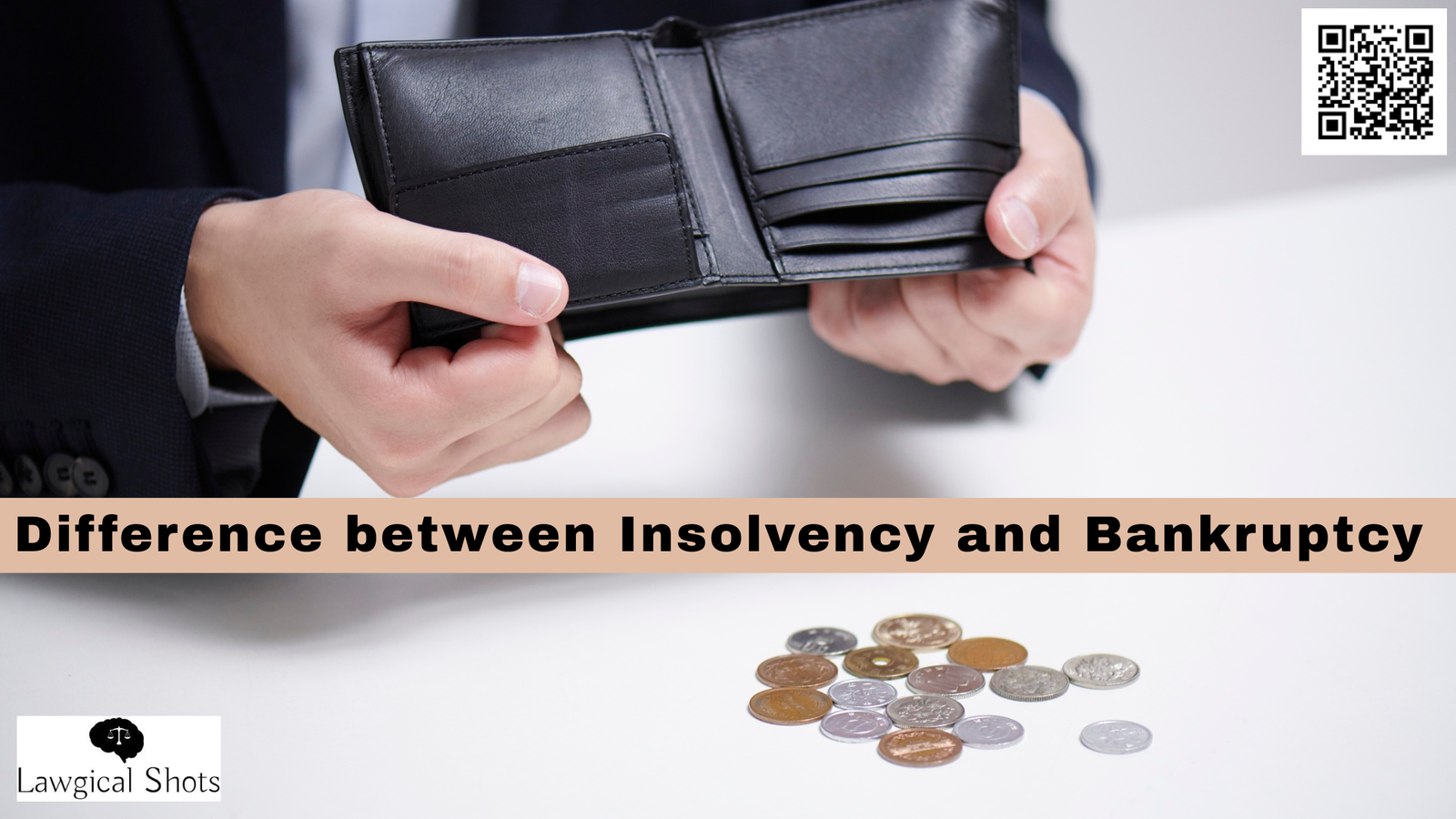
Insolvency is a financial condition where a person or company is unable to pay its financial debt as they become due. In simple words, Insolvency arises when the liabilities of a person or company are greater than the available assets or funds which is making it difficult to meet the dues and financial obligations.
It is a state of financial distress and not a legal status. For example, Kanishkar earns ₹70,000 per month. He has
- A Home loan EMI of ₹45,000
- A Car loan EMI of ₹25,000
- Credit Card dues of ₹15,000
His monthly liabilities become ₹85,000 which is higher than his income. Even though he owns a Kia Car and a house, he cannot pay his regular debts when becomes due. Kanishkar is insolvent as he is unable to meet his financial obligations.
There are two main types of Insolvency:
1. Cash flow Insolvency:- Where a company or individual does not have enough liquid assets or cash to pay their debts immediately.
2. Balance Sheet Insolvency – Where the liabilities of a company or individual exceeds assets.
Under the code of IBC, Insolvency is considered as a stage of financial distress that may still be resolved. It focuses on “Resolution” first which means the attempts are made to revive tor restructure the business before shutting it down.
Interpretation of Insolvency
From the practical perspective, Insolvency is like a warning to the creditors or investors which shows the financial health or illness of a person. However, it is not a complete failure. Many Persons and business become temporarily insolvent due to economic slowdown, unexpected and unforeseen losses and market fluctuations.
For example, a business may own factories worth of crores but still fail to pay salaries and loans because sales have reduced which can be temporary. Thus, Insolvency is seen as a financial condition rather than a final legal status.
Meaning of Bankruptcy
Bankruptcy is legal declaration given by the courts or competent person when an insolvent party is unable to meet their own debts through any other means. It is usually followed by insolvency.
Legally, Bankruptcy is a process where court involves in regulation, administration and equitable allocation of assets to the creditors according to the law. It is a legal pronouncement which brings the financial affairs under judicial supervision.
Under IBC 2016, Bankruptcy is mainly applicable to individuals and partnership firms while for companies the process usually leads to liquidation. In simple words, Bankruptcy is the legal declaration of Insolvency.
Interpretation of Bankruptcy
Bankruptcy recognizes the final stage of financial collapse. After the failed attempts made to recover or reorganize the assets, the legal intervention becomes necessary.
When a person is declared bankrupt, they may lose the control over their assets, face restrictions and several reputational consequences. With the proceedings of bankruptcy, Companies can lead into liquidation where assets are sold to repay creditors.
For example, A businessman continues to default on repayment of bank dues and Creditors approached the court. Court officially declares him bankrupt and his assets are allocated among the Bank and other creditors.
Therefore, Bankruptcy is a legal declaration and process of repaying creditors rather than a mere financial condition.
Difference Between Insolvency and Bankruptcy
Insolvency refers to the state of financial illness and inability to pay the debts where the liabilities exceed the assets. It is a financial condition. However, bankruptcy is legal remedy and process initiated after insolvency becomes unresolved.
Another important difference between bankruptcy and insolvency is that latter may be temporary and can be revocable. A state of financial illness may be recoverable by restructuring loans, selling assets or obtaining loans. However, Bankruptcy is a formal legal intervention which often results in legal administration or liquidation of assets to repay the debts to creditors.
Further, Insolvency does not automatically include Court proceedings. An Insolvent may negotiate with creditors privately and continue operations. However, Bankruptcy includes initiation of court proceedings by administering the property.
Thus, While Insolvency is the recognition of financial inability to repay the debts, bankruptcy is the legal initiation and declaration of that inability to pay.
Tabular Difference Between Insolvency and Bankruptcy
| Basis | Insolvency | Bankruptcy |
| Meaning | Inability to repay debts | Legal recognition and declaration of inability to repay the debts |
| Nature | It is a Financial Condition | It is a Legal Process |
| Scope | Individuals, firms and Companies | Mainly Firms and Individuals; Companies result into liquidation |
| Objective | Recovery and Financial Resolution | Distribution of Assets among Creditors |
| Stage | It is an initial stage of financial distress | It is followed by Insolvency |
| Involvement of Court | Not Mandatory | Involvement of Necessary legal Proceedings |
| Chances of Recovery | High possibility through restructuring and | Bankruptcy often leads to Administration or liquidation |
| Resolution | It can be settled through Negotiating with Creditors | It is a matter of Court |
| Outcome | Despite insolvency, Continuity of business is still a possibility | Liquidation or restructuring can lead to collapse of business. |
Relationship between Insolvency and Bankruptcy
Although the terms are different, they are closely interlinked. Bankruptcy is followed by Insolvency if the financial crisis cannot be resolved.
In simple words,
- Insolvency is the financial difficulty
- Bankruptcy is the legal declaration and provides legal solution.
For example, if a businessman is unable to repay his debts, he becomes insolvent. If creditors approach the court and the court officially declares him bankrupt, then he enters bankruptcy proceedings under judicial supervision.
Both the terms deal with inability to repay debts, people use them interchangeably. However, not every insolvency turns into bankruptcy. Some persons or companies recover through restructuring, settlements or with improved business performance.
Insolvency and Bankruptcy Law in India
The Insolvency and Bankruptcy Code, 2016 is Indian law which consolidated several Indian laws which aimed at time bound resolution and creditor driven possession mechanism in India. Before IBC, insolvency was governed by multiple laws which caused delays and confusion.
The adjudicatory body for individuals and firms is Debt Recovery Tribunal (DRT), while for the Corporate Persons it is National Company Law Tribunal (NCLT).
The aim of IBC 2016 is to consolidate and amend the laws related to reorganization and insolvency resolution of firms, individuals and corporate persons with the primary goals of time bound mechanism, balancing stakeholder interests, maximization of asset value, promotion of entrepreneurship and improve credit availability.
Conclusion
Insolvency and bankruptcy are related but cannot be used interchangeably. As both are distinct concepts in law, Insolvency refers to mere state of financial distress, while bankruptcy refers to legal declaration of such inability to repay debts. Insolvency may be temporary which can be restructured, whereas bankruptcy involves initiation of formal legal proceedings and administration of assets.
Although the two terms are used synonymously in common language, understanding their legal distinction us necessary as they hold distinct legal consequences. The Insolvency and Bankruptcy Code, 2016 has played a significant role in explaining these concepts and created a organized framework to boost the economy by dealing with financial distress in India.
In simple terms, Insolvency is financial inability to repay debts, while bankruptcy is the legal mechanism to address that problem when recovery become tough.