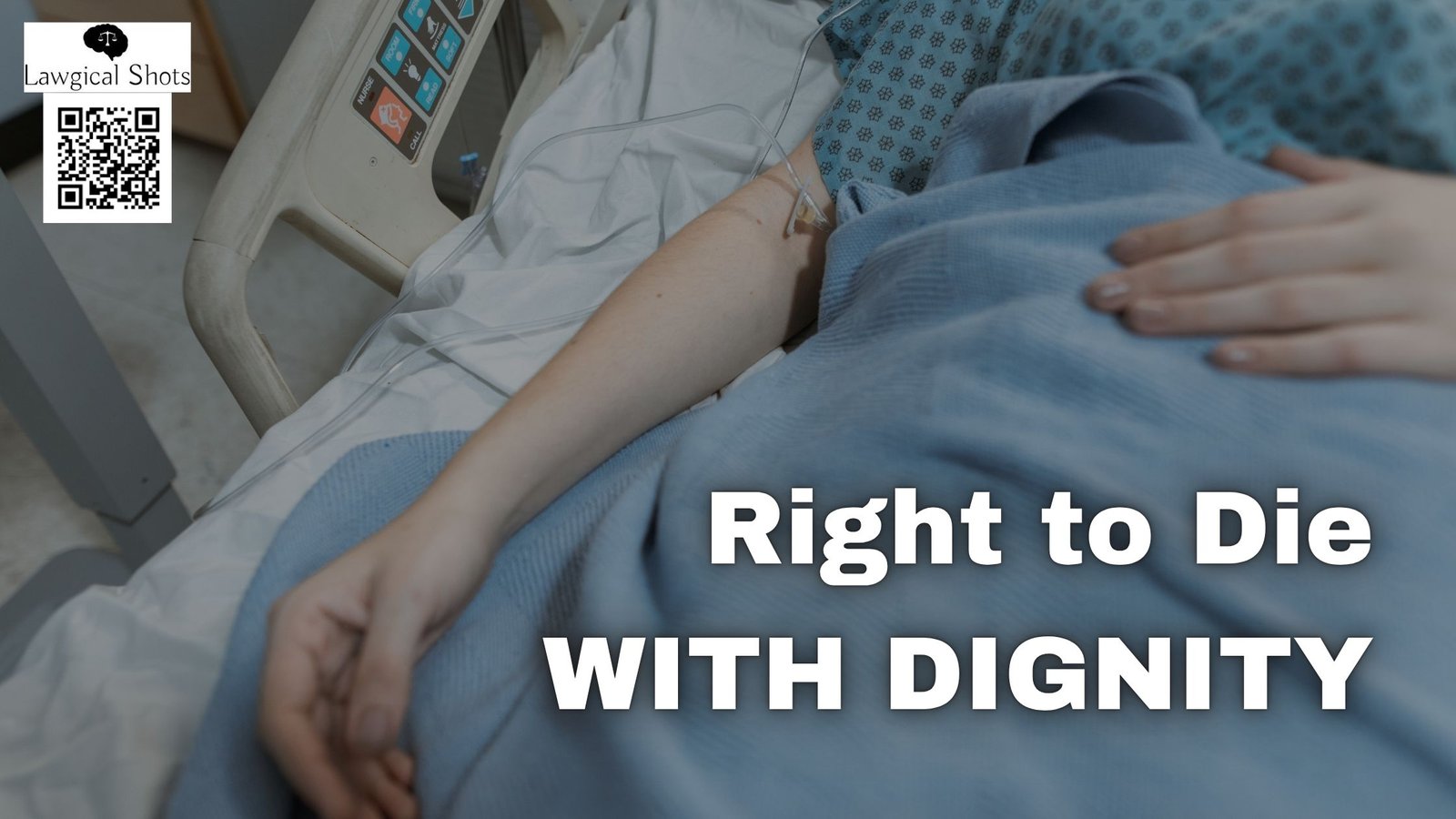

Imagine a person lying silently on a hospital bed for years, unable to move, speak or recognize their loved ones. Machines breathe for them, tubes provide nourishment and life continues only through medical intervention. For the family standing beside the bed every day, hope slowly turns into helplessness. In such a situation, an uncomfortable yet inevitable question arises- does the right to live include the right to die with dignity?
The Indian Supreme Court has grappled with this question for decades. Through its evolving jurisprudence, the court has recognized that dignity does not disappear at the threshold of death. Instead, it remains a essential component of human existence, protected under Article 21 of the Constitution of India.
Article 21 and Right to Dignity
Article 21 guarantees No person shall be deprived of his life or personal liberty except according to procedure established by law. There is no direct mention of right to dignity under the original provision. However, the Supreme Court has expansively interpreted this provision to incorporate the concept of dignity.
Beginning with Maneka Gandhi v. Union of India (1978), the Supreme Court held that the right to life and personal liberty under Article 21 is not limited to mere physical existence, but includes the right to live with dignity, autonomy and meaningful existence.
Right to Die with Dignity
If dignity forms an inseparable part of life, the natural question follows: Should the Constitution also protect dignity at the end of life?
Yes, this has been clarified in the case initiated by Common Cause, which led to a landmark ruling on the right to die with dignity in India. After approaching the Supreme Court of India in 2005 under Article 32, the matter was referred to a Constitution Bench due to conflicting judgments in Aruna Ramchandra Shanbaug v Union of India, 2011 and Gian Kaur v State of Punjab, 1996. On March 9, 2018, a five-judge bench led by Justice Dipak Misra recognized the right to die with dignity as a fundamental right under Article 21, and legalized advance medical directives (“living wills”) as part of personal autonomy and bodily integrity.
The Court has interpreted Article 21 to mean that “life” is not just mere biological survival but a life with dignity. If a person is in a permanent vegetative state or suffering from a terminal, incurable illness with no hope of recovery, forcing them to remain on artificial life support is seen as a violation of their dignity and bodily autonomy. The Court was well verse with the misuse of this liberty and cautiously delineated passive euthanasia as against active euthanasia.
Crucial Terms on Right to Die
| Living Will | Active Euthanasia | Passive Euthanasia |
| A Living Will is a written legal document wherein a person during his life time clearly states his wish regarding medical treatment in case they become terminally ill or unable to communicate. | Causing death directly through Injection | Withdrawal of life support Systems such as Ventilators, feeding- tubes or medication to allow natural death. |
| This allows a person to refuse any kind of life support. | Intentional medical intervention to end life | Ending life by stopping the treatment |
| Illegal | Legal and Recognized by Supreme Court through 2018 Common Cause Judgement. |
Current Status of Passive Euthanasia in 2026
The Supreme Court of India in the following Harish Rana judgment allowed withdrawal of life-sustaining treatment (including CANH) for a patient who has been in a vegetative state for 13 years, following Common Cause v. Union of India (2018) guidelines.
The Court held that the right to die with dignity includes proper palliative and end-of-life care. Here in this case, Right to Die under Article 21 of the Constitution has been interpreted by the Supreme Court as part of the broader right to life with dignity. Article 21 does not merely guarantee survival or biological existence. Rather, it ensures a life that is meaningful and dignified. In this judgment, the Court reaffirmed that dignity is the core of the right to life, and this dignity extends until the end of life. Therefore, the right to live with dignity also includes the right to die with dignity, particularly in situations where a person is terminally ill or in a permanent vegetative state with no hope of recovery. However, the Court makes an important distinction: it does not recognize a general “right to die” or to end one’s life, but only a right to allow the natural process of death to occur in a dignified manner.
The judgment explains that this right is grounded in the principles of autonomy, self-determination, and bodily integrity. Every individual has the freedom to make decisions regarding their own body, including the right to refuse unwanted medical treatment. When medical interventions merely prolong life artificially without improving the patient’s condition, continuing such treatment may violate the person’s dignity. In such cases, withdrawing or withholding life-sustaining treatment is considered constitutionally permissible. This is known as passive euthanasia, which the Court approves since it does not cause death but merely permits the underlying illness to take its natural course.
At the same time, the Court clearly distinguishes passive euthanasia from active euthanasia, which involves a direct act to end life, such as administering a lethal injection. Active euthanasia is not permitted under Article 21 because it introduces a new cause of death and violates the sanctity of life. The Court emphasizes that the key difference lies in whether death is being caused or merely allowed to occur naturally. Thus, while the Constitution protects the sanctity of life, it also recognizes that forcing a person to live in a state of irreversible suffering or complete loss of awareness may be inconsistent with human dignity.
The importance of recognizing the right to die with dignity lies in its humane and balanced approach. It respects individual choice while maintaining the value of life. It ensures that patients are not subjected to unnecessary suffering through futile medical treatment and provides legal clarity to doctors and families in making end-of-life decisions. Ultimately, the judgment harmonizes the principles of the sanctity of life and the quality of life, affirming that the Constitution does not support an undignified prolongation of life but guarantees a dignified end consistent with human values.
Inference
The recognition of the right to die with dignity under Article 21 ensures that the constitutional guarantee of a meaningful life extends to a dignified end, protecting an individual’s autonomy and bodily integrity even in their final moments.