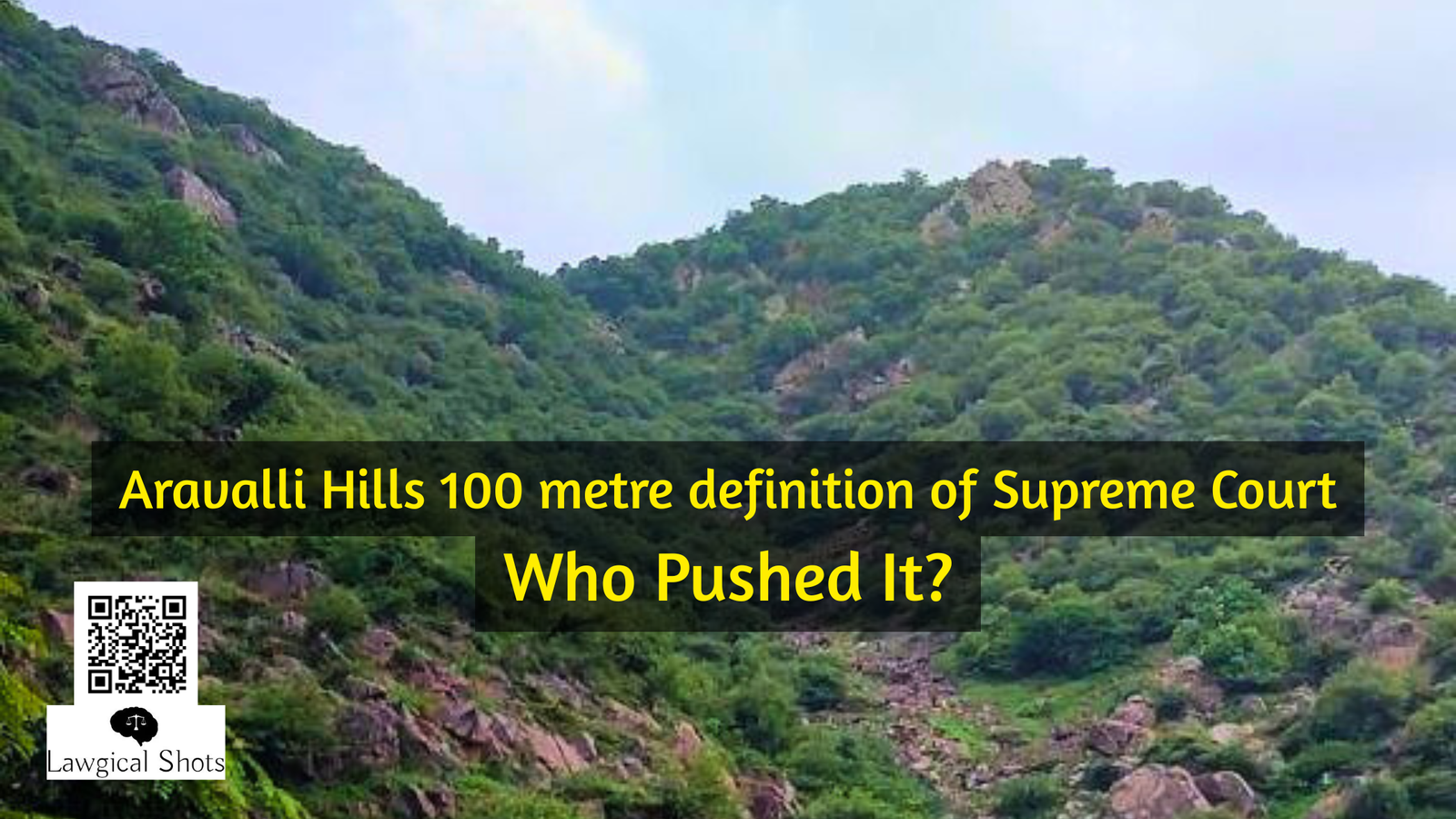

The Aravalli Hills have been standing high since ages across 3 states and the National Capital, that is Delhi. However, the Aravalli hills judgment by Supreme Court has ignited a controversy across the nation. The main reason is Aravalli Hills 100 metre definition which leaves scope for mining and destruction of Aravalli mountain range based on length. Here, we are not going to look at the controversy itself. We will rather focus upon those who proposed, and pushed forward this Aravalli hills’ 100 metre definition, as reflected in the Supreme Court judgment.
Did the Supreme Court impose Aravalli Hills 100 metre definition?
Well, since the Supreme Court judgment on Aravalli hills came out, the Apex Court has been subject to criticism. Social media and other media platforms have flooded with sensational headlines like “Kya Aravali Parvat Katega?”, “What will happen after Aravalli judgment Supreme Court?”, “Aravalli mein kya ho raha hai?”, and most importantly, “What is the definition of Aravali Hills?”. In fact, even though retired, the ex-Chief Justice of India, Justice BR Gavai is also being targeted since he authored the Aravalli hills judgment.
It may be noted that the Apex Court does not itself become an expert in matters related to subjects like science, environment, etc. Since it was about mountains, wildlife, flora and fauna, the Supreme Court sought inputs from specialized agencies of the government. If you yourself read the judgment, you will understand that Aravalli Hills 100 metre definition by Supreme Court was proposed by and backed by different people. The Supreme Court, being the deciding entity, stamped those suggestions.
Aravali Hills Judgment by Supreme Court (PDF)
Who Proposed and Backed Aravalli Hills 100 metre definition
It is a fact that the Aravali ecosystem acts as a “green barrier” and forms an effective “shield” against desertification by preventing the eastward spread of the Thar Desert towards the Indo-Gangetic plains, Haryana and western Uttar Pradesh. The said fact has been admitted in the Supreme Court judgment on Aravalli hills as well. Then who exactly came up with the idea of 100 metre length rule for Aravalli hills? Let’s Find Out!!
Forest Survey of India
A status report by FSI dated in the year 2010 proposed Aravalis as “(i) slope >3°, (ii) foothill buffer = 100m, (iii) inter hill distance or valley width= 500m and (iv) the area enclosed by above defined hills from all sides.” The FSI report proposed Aravalli Hills 100 metre definition has been provided. It further gave the uniform 100 meter wide buffer surrounding the downside of the hills.
Central Empowered Committee (CEC)
The Supreme Court had earlier sought examination by CEC whether the classification of Aravali Hills and Ranges insofar as permitting mining is concerned, needs to be continued or not. The CEC report has attached the FSI report, which gave the 100 metre rule through definition of Aravalli hills.
Indian Council of Forestry Research and Education (ICFRE)
The MoEF&CC had conducted a study by ICFRE to come up with a management plan for Sustainable Mining in Saranda and Chaibasa, Singhbhum District, Jharkhand. The geo-referenced ecological assessment enabled the identification of areas suitable for mining, areas requiring strict ecological protection and zones where biodiversity values necessitated conservation priority. This study paved the way for defining the scope of Aravalli hills.
Special Committee
The Supreme Court through order dated May 9, 2024 had comprised a Committee to come up with a uniform definition of the Aravalli hills and ranges. The said Committee comprised of the following:
- Secretary, Ministry of Environment, Forest and Climate Change, Government of India.
- Secretaries of the Department of Forests, Government of National Capital Territory of Delhi and the States of Haryana, Rajasthan and Gujarat.
- A representative of the Forest Survey of India.
- A representative of the Central Empowered Committee.
- A representative of the Geological Survey of India.
- Joint Secretary, Ministry of Environment, Forest and Climate Change, Government of India, as the convenor of the Committee.
Who Opposed it?
The Amicus Curiae, Shri P. Parameshwar, cautioned the Supreme Court that if the Aravali Hills 100 metre definition was accepted, all the hills below the height of 100 metres would be opened up for mining. This way, the Aravali Hills and Ranges would lose their continuity and integrity. According to him, it would totally endanger the environment and ecology of the mountains.
Why Aravalli 100 metre rule and not Blanket Ban?
As per the Aravalli Hills judgment by Supreme Court, the matter was earlier addressed in State of Bihar v. Pawan Kumar (2022). The Apex Court in that case took note of the “ill consequences of imposing a complete ban on mining activities”. As per the Court, a blanket ban on mining may result in illegal mining activities, land or mining mafias, and criminalisation. The Court had earlier observed that a complete ban was not in the environmental interest, since it gives scope for illegal mining.
Conclusion
The blog here addressed the very narrative that the Aravalli Hills controversy should not be focused upon the Supreme Court or Justice BR Gavai. Though the Judiciary had the authority and chance to do better while defining Aravalli hills. However, the Apex Court should not be burdened and other decision participants should not be overlooked in the process.
The experts may be right, the experts may be wrong. But the reasoning that millions of labourers are dependent upon the mining activities should not be the justification for destroying nature. Since Aravali hills cover the major NCR region, we are already dealing with an extreme air pollution crisis. Another blow upon the saviour mountains of the region in the name of sustainable mining may not be as sustainable for the living, be it humans or the wildlife. If you know, you know!!