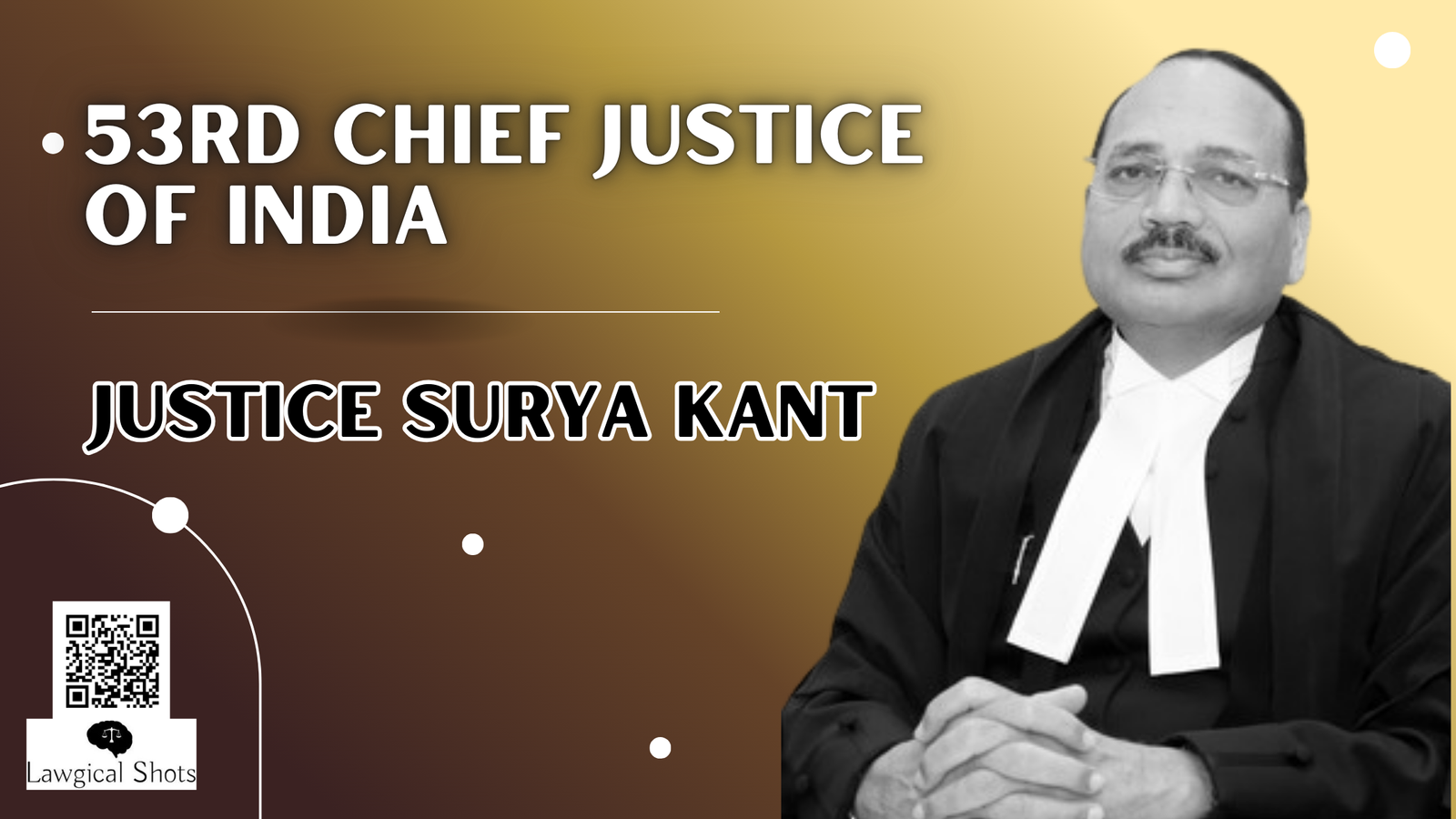

On 24 November 2025, Justice Surya Kant has been sworn in as the 53rd Chief Justice of India (CJI). The ceremony took place at the Rashtrapati Bhavan, where President of India Droupadi Murmu administered the oath of office.
Justice Surya Kant succeeded Justice B. R. Gavai, and is expected to serve as the Chief Justice of India until 9 February 2027.
Attendees of the swearing-in ceremony of CJI Kant included dignitaries from India’s judiciary, Prime Minister Narendra Modi and other cabinet ministers. There was some international representation as well wherein delegations of judges from countries such as Bhutan, Kenya, Nepal, Malaysia, Mauritius, and Sri Lanka were present, underscoring the event’s diplomatic and judicial significance.
Personal and Educational Details
Justice Surya Kant was born on February 10, 1962 at Hisar (Haryana) in a middle class family. In 1981, he completed his graduation from the Government Post Graduate College, Hisar. Later, he earned his bachelor’s degree in Law in 1984 from Maharishi Dayanand University, Rohtak.
Legal Practice of Justice Kant
As a young law graduate, Justice Surya Kant started practicing law at the Hisar District Court, Hisar soon after graduation. Soon in 1985, he moved to Chandigarh to practice before the Punjab and Haryana High Court. Justice Kant stood First Class First in his Master’s degree in Law in 2011, earned from the Directorate of Distance Education, Kurukshetra University, Kurukshetra. Being specialised in Constitutional, Service and Civil matters. Justice Surya Kant, during his practice years, represented a number of Universities, Boards, Corporations, Banks, and even the High Court itself. He even earned distinction of being appointed the youngest Advocate General for Haryana on July 7, 2000.
Litigation Years
In March, 2001, Justice Kant was designated as a Senior Advocate. Before being elevated as the permanent Judge of Punjab andHaryana High Court on January 9, 2004, he held the office of Advocate General, Haryana for almost 4 years.
Justice Jant on February 23, 2007 was nominated as a Member of the Governing Body of National Legal Services Authority for two consecutive terms till February 22, 2011. On October 5, 2018, Justice Kant assumed charge as the Chief Justice of the Himachal Pradesh High Court.
Elevation to the Bench
Justice Surya Kant got elevated as a Judge of the Supreme Court of India on May 24, 2019. He also serves as the Chairman of the Supreme Court Legal Services Committee, since November 12, 2024. While taking oath as the Chief Justice of India on November 24, 2025, Justice Surya Kant is member of various Committees of the Indian Law Institute (ILI – a deemed university under the aegis of Hon’ble Supreme Court of India).
Justice Kant will be serving as the Chief Justice of India for a few months more than a year and is due to retire on February 9, 2027.
A New Journey of CJI Justice Surya Kant
Justice Surya Kant’s swearing-in as the 53rd Chief Justice of India marks a notable chapter in India’s judicial history. The appointment of Justice Surya Kant as the 53rd Chief Justice of India reflects upon the constitutional process under Article 124, where seniority and collegium recommendations play a key role. Being the CJI, As CJI, he will not only preside over contentious benches but also have significant say in bench constitution, judicial administration, and policy direction.
Some of the key challenges and expectations for Justice Surya Kant’s tenure include:
- Judicial Backlog & Access to Justice: With his experience in legal services, there is hope he will emphasize reducing pendency and increasing institutional support for underprivileged litigants.
- Balancing Rights & Security: Given his role in the Pegasus case, his approach to privacy and state power will be closely watched.
- Electoral Integrity: His past engagement with electoral roll issues suggests he may push for greater transparency and accountability from institutions like the Election Commission.
- Gender Parity: His rulings on gender justice (e.g., bar association reservations) could influence further reforms.