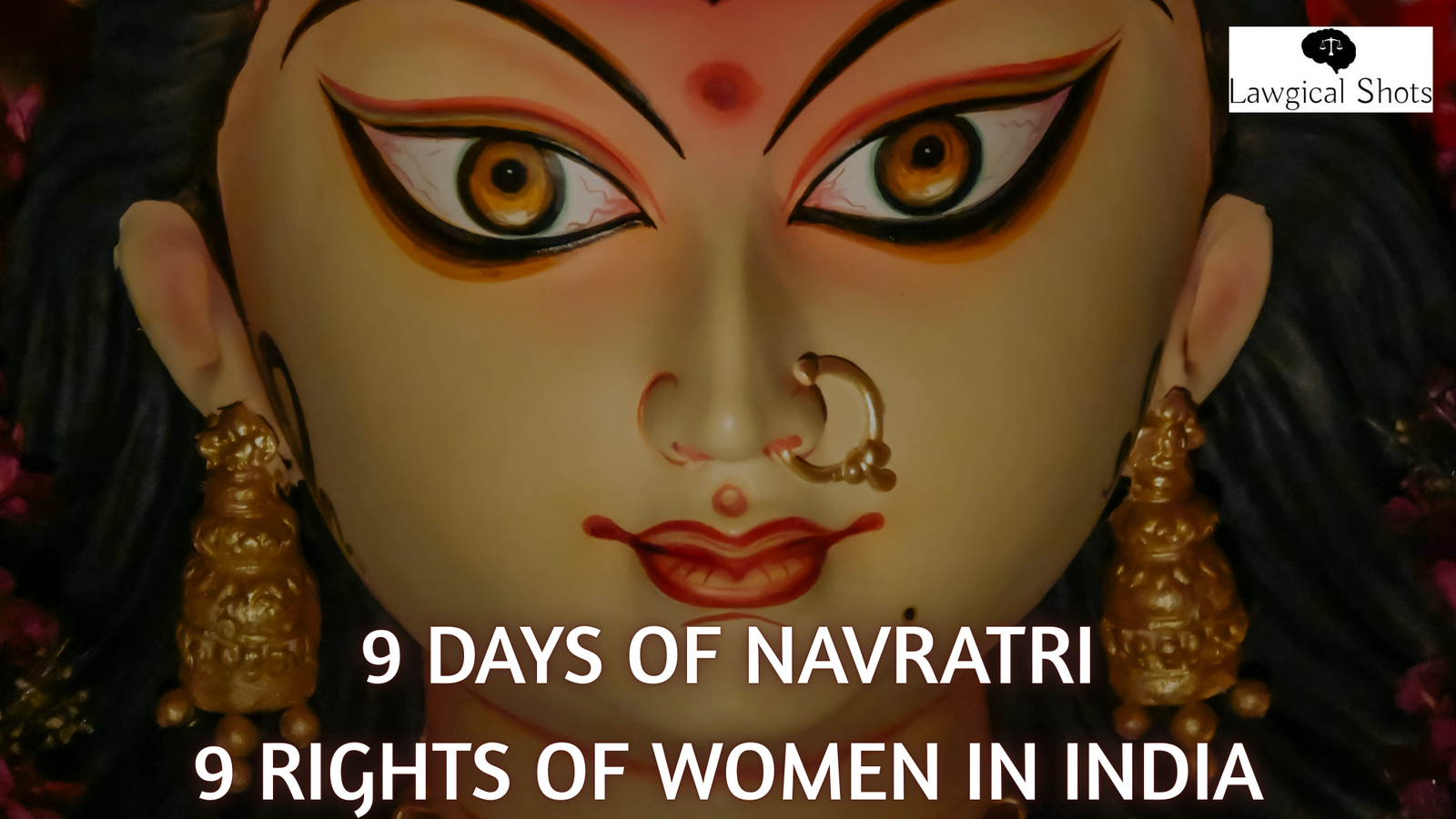

Navratri means 9 nights – a festival of colours, lights, devotion and woman power. However, how many of us can relate the 9 forms of Goddess Durga to real women around us? How common is it for us to discuss rights of women in India that align with the idea of a fortress that Goddess Durga is? Rare…..Right? That’s why we took this opportunity to lay down the various women’s rights in India that empower women in our country, regardless of whether she is a devotee of Shakti, or a woman from another celebrated religion in India. Let’s take a ride through Navratri and Nav (9) rights of women.
Understanding 9 Days of Navratri
In Hinduism, Navratri occurs twice in a year – first during Chaitra month (March-April) as per Hindu calendar, and then during Sharad month (September-October). Different forms of Goddess Durga are worshipped and celebrated during these nine days, or nights as Navratri depicts. Fasting, Havans, Pandaal decorations during Durga Pujo and Garba nights are a different glimpse from various parts of India.
The 9 days of Navratri depict 9 different forms of Goddess Durga. The first to ninth forms aree explained below:
- Shailaputri: The first form is Devi Shailputri – the daughter of Himalayan mountains and is depicted as riding a bull. . She represents strength, stability, and new beginnings.
- Brahmcharini: Holding a rosary and a water pot, this form of Goddess symbolizes austerity. Brahmcharini embodies penance, discipline, and devotion, signifying the path of self-study and focus.
- Chandraghanta: Being the fierce warrior Goddess with a crescent moon on her forehead like a bell, she brings courage and fearlessness, and blesses devotees with inner peace.
- Kushmanda: She is the creator of the entire universe, spreading positivity and optimism with her radiant smile.
- Skandmata: Portrayed as the mother of Skanda, this nurturing form is the mother of Lord Kartikeya, the commander of the gods. She embodies care and compassion.
- Katyayani: The slayer of demons, Devi Katyayani is the strong and fearless protector and slayer of demons, representing courage and integrity.
- Kalaratri: The fierce and dark form of the goddess, she is the destroyer of darkness and ignorance, symbolizing resilience and the ability to overcome negativity.
- Mahagauri: Symbolizing purity, peace, and divine wisdom, Devi Mahagauri shines brightly and embodies a peaceful presence.
- Siddhidatri: The final form, the giver of Siddhi (spiritual powers) is a guide to fulfillment and holistic development.
Nine Rights of Women in India
Knowing the 9 forms of Goddess Durga is not enough if women do not recognize the Goddess Durga within. There are various women’s rights in India enshrined under various laws which empower women. Here is an explanation of how Indian laws strengthen womanhood.
Right to Equality
If we look at the Constitution, the right to equality includes the right to equal opportunity in public employment. It may be noted that the laws for rights of women in India will prove ineffective if women are discriminated against for what they are paid. Therefore, the The Equal Remuneration Act, 1976 or the New labour Code on social security ensures that women are paid equally as that of men for the equal work done. The right to Protection from Sexual Harassment at Workplace ensured through the Sexual Harassment of Women at Workplace (Prevention, Prohibition and Redressal) Act, 2013 further ensures dignity for women at workplace. The POSH Act allows women to work against all odds, including those who belittle women through sexual remarks or advances.
Right to Shape her Life
Stereotypically speaking, when a girlchild is born in India, she lives under the aegis of her father’s name, following his decisions. Once married her husband’s name replaces her father’s guardianship. However, the Courts have time and again empowered women who choose to shape their own lives. Those who wish to have their mother’s surnames instead of their fathers for whatever reason, the Courts have entitled them to use their mother’s surname. At the age of adulthood, women have been empowered by Courts to choose who they wish to spend their lives with – whether it is a husband of their own choice, or a lesbian partner.
Courts have time and again clarified that a daughter who has attained the age of majority can decide whom she wants to marry or where she wants to reside. Courts even extend couples who get married and face death threats from their families. Courts especially extend protection to such couples to prevent Honour Killings of daughters or their spouses.
Right to Motherhood
Speaking of reproductive decisions of a woman, they say being a mother is a blessing; Since women are blessed in that aspect, giving birth is a rollercoaster journey for a woman who does not feel herself ever again. While a woman has to face a lot of bodily changes, the uncertainty of losing her livelihood, her job, just because she won’t be able to work during pregnancy is discriminatory. The Maternity Benefit Act, 1961 ensures that no woman loses her job, and even gets paid for a certain period during pregnancy and after giving birth. Even in case of miscarriage, a woman’s body needs healing, and that aspect is squarely covered under the 1961 Act.
Right to Reproductive Autonomy
Traditionally, a couple is expected to have babies after getting married. However, is it a mandate upon women to have kids after marriage? Is it illegal for a woman to be pregnant before marriage? And what about a woman who gets pregnant by chance and does not wish to have the baby? As per Indian laws, whether or not she wants to have a child is her choice. The abortion rights under Medical Termination of Pregnancy Act strengthen reproductive autonomy for a woman in India.
Whether or not a woman wants a child is an important aspect to discuss. A man can get away by abandoning the woman he impregnated, but a woman who ends up getting pregnant without any plans should not suffer. The Medical Termination of Pregnancy Act, 1971 ensures that a woman has the option to undergo medical termination of pregnancy (legal abortion) within a few weeks of pregnancy as specified under the Act. Beyond that, she may approach the Court and in specific circumstances, the Court may allow abortion within a specific gestational period.
Right to Dignity
The history reeks of patriarchal society in India where men are decision makers and women follow their instructions. If she failed, she would deserve to be beaten up and taught a lesson. That’s about what happened in the past, for women in this era, the Protection of Women from Domestic Violence Act, 2005 protects them. Any woman in a shared household, whether it is a daughter, a wife, a mother, or even a live-in partner, is entitled to protection under the DV Act. Sections 85 and 86 bring a criminal garb for Cruelty against a married woman. The husband and his relatives treating a woman with cruelty face the shackles of criminal law. That’s how Indian laws reaffirm the dignity of women in Indian households.
Stepping outside the house and relations, there are lecherous beings who make it challenging for women to live freely. Criminal provisions that punish voyeurism, stalking, obscenity, etc., and the Indecent Representation of Women (Prohibition) Act, 1986 uphold dignity rights for women in India.
Be it within the four walls, their own locality, workplace, or public transport, women do not owe anyone anything for their own liberty. Thus, dignity is not just a good deed but a woman’s invincible right against the world.
Right against Exploitation
During Navratri, women are celebrated in Devi form in India. This is the same India where women are considered vulnerable and the menace of trafficking for prostitution still exists. India fights it through the clutches of The Immoral Traffic (Prevention) Act, 1956.
Stringent rape laws after Nirbhaya case, and criminal law provisions which laying for arrest of a woman during specific hours of the day in the presence of a woman police officer further establish women’s right against exploitation.
Even those girls protected in families, child marriage has been a curse pushing them into marital responsibilities and carrying children at a tender age. The Prohibition of Child Marriage Act, 2006 is just another facet of the law which aims to protect rights of women in India against being hitched into a marital relation without clear understanding of the norm.
Rights of Married Women in India
Marriage in India is a sacred union, portrayed to be blessed through heavens. The laws for rights of women in India particularly ensure that after marriage, women still pursue a dignified life. Scanning through history, India has had a prolonged fight against female foeticide which had a stronger impact on male versus female ratio in several states. Why is a girl child not welcome here? Because having a girl would mean a burden. The parents would have to take care of her upbringing, she would leave them after marriage, and for getting her married, they would have to pay a huge dowry to the groom.
The Dowry Prohibition Act, 1961 seeks to put an end to the dowry system in India. It punishes those who demand dowry in the name of marriage, and also punishes those who comply with the demands and give dowry for marriage.
Even after marriage, a woman is entitled to seek divorce from her husband on specific grounds. The law makes sure the woman is not left a destitute, through provisions for maintenance and alimony. In case of the untimely death of her husband while still being married to him, the various women’s rights in India also include the widow’s right to get married again. A divorced woman is also entitled to remarriage.
Women’s Right to Property
Indian family values often require a woman to refrain from having anything to do with her parents’ property. The Hindu law earlier did not entitle daughters on an equal footing as sons for succeeding an ancestral property. However, the Hindu Succession (Amendment) Act, 2005 entitled women to have equal rights in ancestral property as that of their brothers. For a married Hindu woman, all the gifts and ornaments she receives at the time of marriage is her Stridhan, her exclusive property. In Muslims, dower or Mahr is the exclusive property of a married Muslim woman.
Regardless of her religion, the rights of women in India also include the right to own property. In other words, nothing in law restricts a woman from owning a property. She can inherit property based on applicable personal laws.
A Special Authority for Women
The National Commission for Women Act, 1990, as the terminology suggests, laid about the constitution of a Commission at the National Level dedicated to women and their welfare. The NCW is majorly responsible for investigating and examining matters related to the safeguards provided for women under the Constitution and other laws.
If someone feels that any of her aforementioned rights of women in India have been compromised, she may approach the NCW with a complaint and they will be assisted as per due process of law.
Conclusion
Worshipping Goddess Durga during Navratri is a matter of religious practice among Hindus. However, women’s rights are not restricted to one specific religion. Durga means the invincible, the unassessible, the unattainable. That’s how women are, provided that they recognize the fortress in themselves and seek legal assistance as and when required, to defeat the devil.